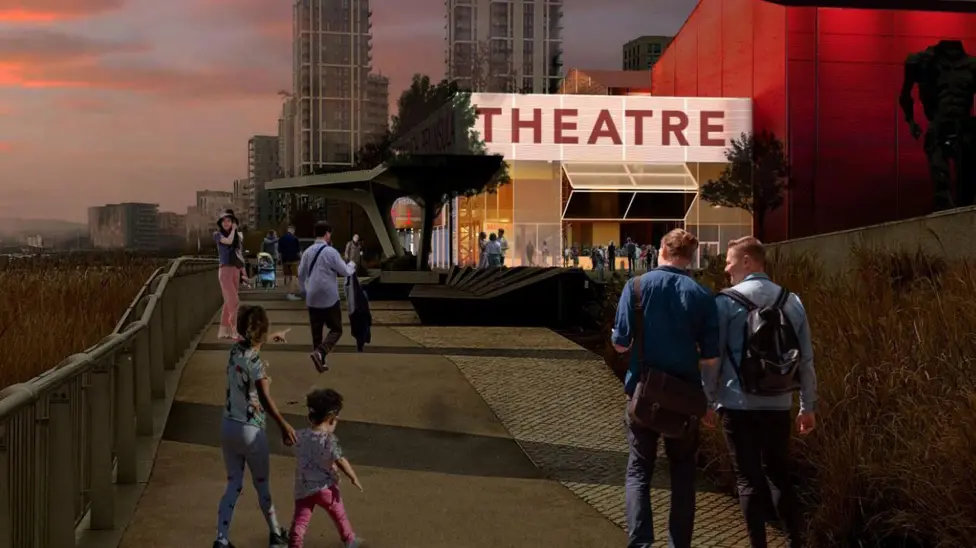
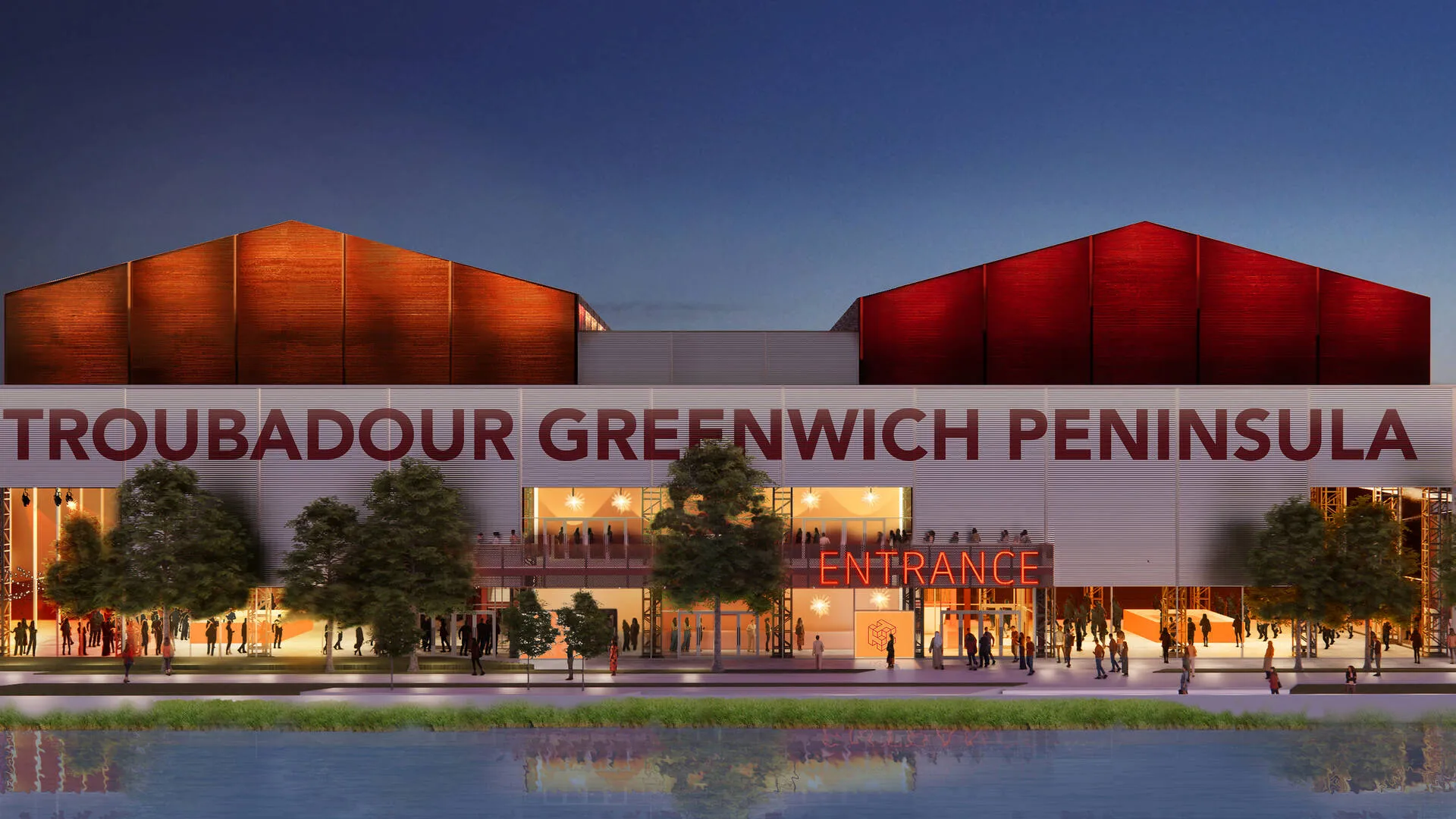
Greenwich Council has granted planning permission for a new Troubadour Theatres venue on the eastern side of Greenwich Peninsula, close to the cable car terminal, on land currently used as a coach park and associated site accommodation. The scheme totals 3,000 seats across two 1,500-seat auditoria, overtaking the London Coliseum (2,359 seats) on dedicated theatre seating.
The plans describe the venue as a 10-year “meanwhile use” project, using a demountable structure designed to be temporary, before the site ultimately comes forward for housing as part of the Greenwich Peninsula Masterplan. In other words, this is a major cultural venue with a built-in expiry date, which makes the design choices and operational impact even more important.
Construction is expected to start in June, with the build likely taking around nine months once work begins. Industry reporting suggests the venue is aiming for an opening in late 2026, with programming to be announced in due course.
Troubadour, which already operates venues at Wembley Park and Canary Wharf, said the development would further expand London’s cultural landscape and “deliver unforgettable experiences for audiences for years to come”. Joint founders and chief executives Oliver Royds and Tristan Baker called the decision a major milestone and an exciting new chapter in their commitment to bold, large-scale live performance.
The Canary Wharf venue opened last October and is home to a theatrical adaptation of The Hunger Games. At Wembley, Andrew Lloyd Webber’s Starlight Express is currently playing.
Alongside the headline capacity, the published design information gives a clearer picture of how the complex intends to work day-to-day: two main foyer bars, plus a flexible mezzanine level that can operate as VIP space or a restaurant, including use by the public outside performance times. The venue’s stated opening hours run up to 1am, with typical show slots listed as 3–6pm (matinee) and 7–10pm (evening), which brings crowd flow, late dispersal and local impact firmly into the conversation.
What the decision means for the site
Planning permission has been granted for a temporary period of 10 years. After that, the land near the cable car station will eventually be used for residential tower blocks as set out in the Greenwich Peninsula Masterplan.
Approval was given at a meeting of the council’s planning board last week.
Local community voices
Sylvia Williams, speaking on behalf of the Greenwich Millennium Village Residents’ Association (GMVRA), supported the plans as a welcome addition to cultural life on the Peninsula and urged a condition allowing local schools to use the theatre.
Troubadour’s chief operating officer Rowley Gregg said it was a key desire for the theatre to support the community, and referenced the Troubadour Trust, which uses 50p from every ticket sold at a Troubadour venue to support local communities via workshops and ticket schemes for schools and charities.
Not everyone approached the plans with uncomplicated enthusiasm. Reporting around the planning meeting noted resident concerns about potential noise and late-night activity, plus questions about the building’s appearance and lighting. Those tensions are part of the story, because a venue can be culturally valuable and still need firm safeguards to keep neighbours onside.
Comparable venues and the capacity conversation
The new venue leads on dedicated theatre seating, though London’s largest arts complexes often spread similar totals across multiple spaces. The Barbican, for example, totals 3,299 seats across Barbican Hall (1,943), the Barbican Theatre (1,156) and The Pit (200), alongside three cinemas. Meanwhile, the Royal National Theatre houses three main auditoria with a combined total often cited at roughly 2,400 to 2,500 seats.
Those comparisons matter because capacity is a headline, while experience lives in the detail.
One further point worth adding: this venue is being discussed in the industry as a receiving house for large-scale productions and international live entertainment. That ambition can be exciting, but it also puts even more weight on the fundamentals, because big shows in big rooms only land when the whole building is designed to support the audience experience.
TheatreLife view: scale has to earn intimacy, and accessibility has to be built in
At TheatreLife, we champion new venues. We also pay attention to what scale does to a live experience.
Really pleased to see plans moving ahead for Troubadour Greenwich Peninsula, but I hope the design team obsess over the two things that make theatre theatre: proximity and accessibility.
A 1,500-seat auditorium can be spectacular, yet it’s also where intimacy has to work twice as hard. If you’re way back in the stalls, or up, up, up in the gods, sightlines, acoustics, and the feeling of “I’m in the room with them” need to be engineered, not assumed. I’ve been in large theatres and there’s a feeling of disconnect. I worry this venue is built to crunch numbers through the doors, and not so much to serve what’s happening on the stage.
At that scale, diversity and access can’t be an afterthought. For example, in a large theatre, surtitles often can’t be seen up in the gods. Reduced rates should be aimed at Londoners who most need them: low-income audiences, disabled people and carers, students, under-25s, key workers, and local community groups. Pricing, outreach, relaxed/captioned performances, and who gets commissioned will decide whether this is a big room for everyone, or just a big room.
Inclusion that feels real
At this scale, inclusion has to be engineered in from the start, not added as an afterthought. The choices made in design and operations will decide whether the experience works for everyone. Any new theatre needs to consider London as a whole, and who feels invited in practice.
Marketing and community outreach that widens the invitation, using targeted campaigns and partnerships to reach underrepresented audiences (including Black and Asian communities, disabled and neurodivergent audiences), and making access information easy to find and trust.
Captioning and surtitles that remain readable from every tier, not just premium sightlines.
Audio description, BSL interpreted performances, and captioned performances programmed regularly, with clear, consistent listing information.
Relaxed performances that support neurodivergent audiences and anyone who benefits from a less rigid environment, backed by front-of-house training that understands sensory needs.
Step-free access that feels integrated, seating plans that avoid segregation, and facilities designed with dignity in mind.
Fair concession policies and community allocations that are easy to access, and meaningful at 3,000-seat scale.
Commissioning and programming that widens opportunity across background, race, disability and neurodiversity, on stage and behind the scenes.
In short: a building can be big and still feel close. The way you get there is by designing for the upper circle and gallery as carefully as the front rows, and by treating accessibility and representation as part of the core theatrical experience.


Add comment