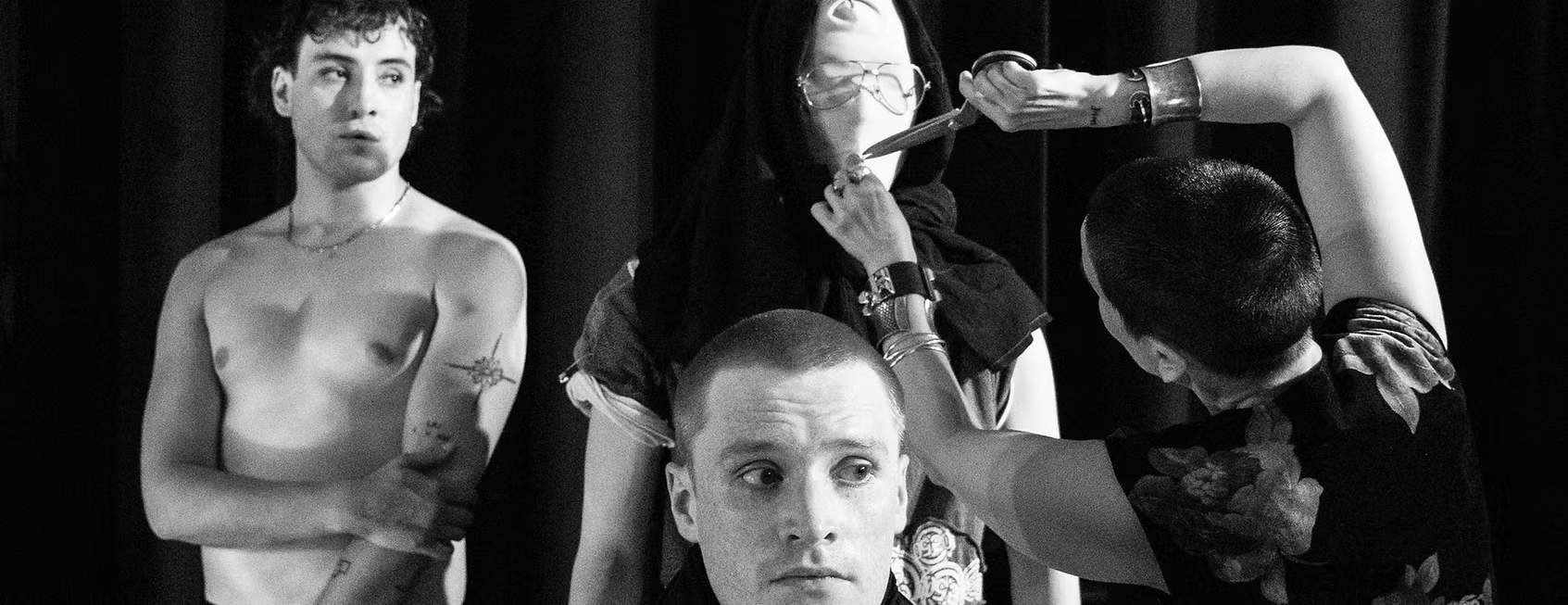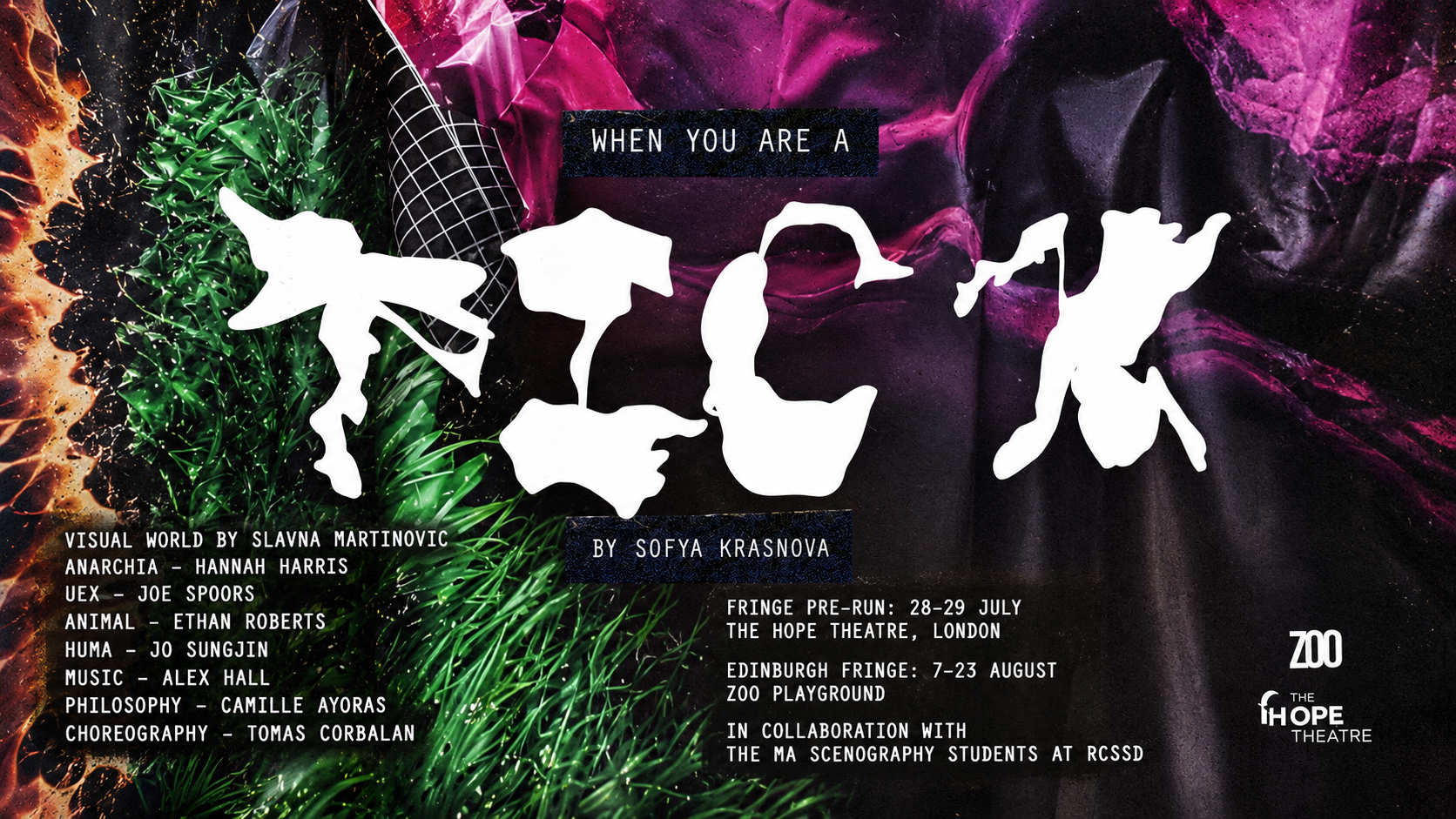
It is not every day that a theatrical evening begins with a car break-in, a stolen briefcase and a sudden descent into radical street philosophy, but Sofya Krasnova’s When You Are a Tick thrives on catching its audience off guard. After Fair Love Collective’s previous four-star success at Camden People’s Theatre, Krasnova returns with a high-octane philosophy-punk comedy that gleefully smashes conventional rules to pieces. By colliding live, punk-edged music, absurd physical comedy and documentary-style testimony, the production transforms complex intellectual theory into a restless landscape of modern human panic.
At its centre is a trio of small-time criminals named Uex, Animal and Huma. After Animal breaks into a car, he returns to their headquarters with a stolen briefcase containing neither drugs nor cash, but a dense book by a philosopher named Frietzsche. Under Uex’s direction, the gang begin treating it as a practical manual for changing reality.
Their attention settles on the Umwelt, the idea that every living creature experiences a world limited by its own perceptions. A tick, for example, inhabits a reality reduced to the warmth and scent of the body from which it feeds. The gang approach this difficult concept with great seriousness and spectacular imprecision.
The pleasure and horror of Krasnova’s writing lie in how quickly abstract ideas become permission for action. Dense thought is flattened into street violence as the gang seize upon intellectual language without developing the patience to understand it. Their attempts to reshape their Umwelt begin comically, with secret gestures, physical exercises and competitive posturing, before developing into increasingly cruel experiments upon other people.
One of the play’s sharpest inventions is Uex’s “Great Violence Debt”, a grotesque system of moral accounting in which every humiliation is stored and eventually repaid. Private pain becomes a universal debt that can be collected from almost anybody. Violence is organised, itemised and presented as fairness; philosophy becomes less a means of enquiry than a bookkeeping system for cruelty.
There is a great deal to absorb within the production’s brisk running time. The discussion moves through possession, perception, memory, identity and tribal classification, and audience members without a background in philosophy may occasionally have to concentrate hard to follow each turn. Some of these ideas can feel slightly disconnected as the play races onwards.
Yet the density is also part of the point. Uex and the others are not careful students building a coherent school of thought. They are scavengers, taking fragments that flatter their existing anger and hammering them into a system that promises purpose, belonging and permission.
The gang’s criminal spiral is interrupted by television-style broadcasts in which puppet figures describe genuine shifts in worldview. Vera, Maria and Jenny speak about religion, domination, motherhood, guilt and survival. Their experiences resist the gang’s desire to divide everything into neat categories. Change can be liberating, damaging, necessary and self-deceiving at the same time. These testimonies place the gang’s counterfeit awakening beside transformations rooted in complicated human experience.
Ethan Roberts stands out as Animal, giving the production a strong emotional centre without disguising the character’s coarseness. Animal claims to understand life through action, desire and physical touch, but Roberts allows the insecurity beneath his bravado to surface gradually. His arrangement with Anarchia is supposedly impersonal, yet he begins to crave precisely the permanence and emotional certainty she refuses.
Roberts handles Animal’s awkward marriage proposal particularly well. It is funny, tender and faintly alarming at once: a sincere declaration expressed by a man whose ideas of love, possession and commitment remain hopelessly entangled. Roberts finds enough vulnerability beneath the swagger to make Animal’s rejection matter, without asking the audience to forget his capacity for cruelty.
Hannah Harris brings intelligent comic sharpness to Anarchia, the self-described relationship anarchist who is physically attracted to Animal but remains unconvinced by his intellectual company. Harris and Roberts develop an enjoyable back-and-forth in their blunt negotiations over sex, freedom and attachment. Their exchanges provide some of the evening’s liveliest comedy while raising a more troubling question: when does intimacy become connection, and when does it begin to resemble possession?
Anarchia also recognises how badly the gang have misunderstood the philosophy they have adopted. Harris delivers her corrections with brisk wit rather than academic solemnity, giving the character an assured presence without reducing her to a mouthpiece for the play’s ideas.
Joe Spoors gives Uex a controlled, increasingly hard edge. As the gang’s ideological architect, Uex can convert resentment into a system persuasive enough to conceal its absurdity. Spoors does not play the reasoning as meaningless nonsense; the danger lies in the calm way every contradiction is absorbed and morally reversed until cruelty appears to restore balance.
He also doubles as the Philosopher, creating a neat connection between the gang’s distorted interpretation and the man whose writing they have seized upon. The Philosopher is more fluent than his accidental disciples, but not necessarily wiser. He remains absorbed in manipulation, desire and verbal games, apparently unwilling to recognise the consequences that ideas may acquire once released into other people’s lives.
As Huma, Jo Sungjin brings a more hesitant presence to the group. Huma adopts Uex’s language and rituals, but retains enough uncertainty to expose the cracks in their developing doctrine. When the division between Snails and Ticks begins to carry a real human cost, his conscience becomes an important counterweight to the others’ certainty.
All four performers fully inhabit the production’s peculiar world, and their strong vocal projection is particularly valuable when dialogue moves rapidly through difficult material.
The distinction between Snails and Ticks is one of the play’s most grotesquely effective developments. What begins as another piece of animal philosophy mutates into a tribal taxonomy, a means of deciding who belongs, who is invasive and who may be destroyed. Once the world has been divided into types, compassion becomes an error and violence starts to feel administrative. The metaphor is ridiculous, but dehumanising categories rarely need intellectual coherence in order to become dangerous. They need only a simple enemy and believers eager for permission to act.
Slavna Martinovic’s adaptable design centres on an exposed rectangular metal frame at the rear of the Hope Theatre’s intimate stage. Using poles, the company raise and drape different materials across it as the settings change. Plain black and white cloths give way to more pictorial backdrops, including an enlarged wedding photograph and an image of fire.
A few of these changes are slightly cumbersome, although this is understandable within such a restricted playing space. More importantly, the frame gives the production a flexible visual language in which reality can be repeatedly covered, removed and replaced, echoing the gang’s conviction that the world can be physically reconstructed.
The live music gives the evening much of its energy. Joe Spoors plays the electronic drum kit to particularly strong effect, providing a raw pulse beneath the action, while Hannah Harris contributes accordion. The actors also break into song at intervals, creating welcome breathing spaces amid the denser philosophical passages. Arguments and slogans become physical, rhythmic and, at times, unsettlingly catchy.
Krasnova and co-director Oliver Bennett move the production between sexual comedy, philosophical debate, puppet testimony, music and violence. The result is deliberately unruly, but a clear progression emerges beneath the surface: ideas are discovered, misunderstood, ritualised and finally used to excuse harm. Jokes become labels; labels become doctrine; doctrine determines who can be humiliated or destroyed.
The final confrontation with the Philosopher sharpens the central irony. Uex and Animal approach him as triumphant students who have imposed their interpretation upon the city. Yet their supposed teacher remains more interested in seduction, manipulation and his own intellectual performance than in accepting responsibility for what his language has inspired. By then, the distance between theory and consequence has become almost impossible to bridge.
When You Are a Tick is strongest when comedy and danger occupy the same moment. Its criminals are ridiculous, but the needs feeding their certainty are recognisable: resentment, loneliness, humiliation and the longing to belong to something that explains the world. Krasnova understands how extremism can look absurd from the outside while feeling coherent and empowering to those already inside it.
The volume of philosophical material occasionally threatens to loosen the dramatic thread, but the production’s originality, committed performances and vigorous use of live music carry it through. This is bold, intellectually restless fringe theatre, full of noise, ideas and theatrical bite. It asks the audience to work, but rewards that concentration with a darkly funny and disquieting account of how easily grievance can disguise itself as truth.
Cast & Creatives
- Showing: 28th – 29th July 2026
- Venue: The Hope Theatre, 207 Upper Street, London N1 1RL
- Buy Edinburgh Tickets: https://www.edfringe.com/tickets/whats-on/when-you-are-a-tick
- Company: Fair Love Collective - https://www.fairlovecollective.co.uk/
- Writer & Director: Sofya Krasnova
- Co-Director: Oliver Bennett
- Set & Costume Designer: Slavna Martinovic
- Technical Curator: Liisa Zukova
- Choreographer: Tomas Corbalan
- Composer & Musician: Alex Hall
- Philosophy Consultant: Olivier Verseau
- Cast:
Hannah Harris as Anarchia and accordion
Joe Spoors as Uex and the Philosopher, and drums
Jo Sungjin as Huma
A Fiercely Original Philosophy-Punk Comedy With Real Theatrical Bite
Summary
When You Are a Tick collides live music, physical theatre and puppet testimonies in a darkly funny, intellectually restless exploration of radicalisation, isolation and the seductive certainty of dangerous ideas.


Add comment