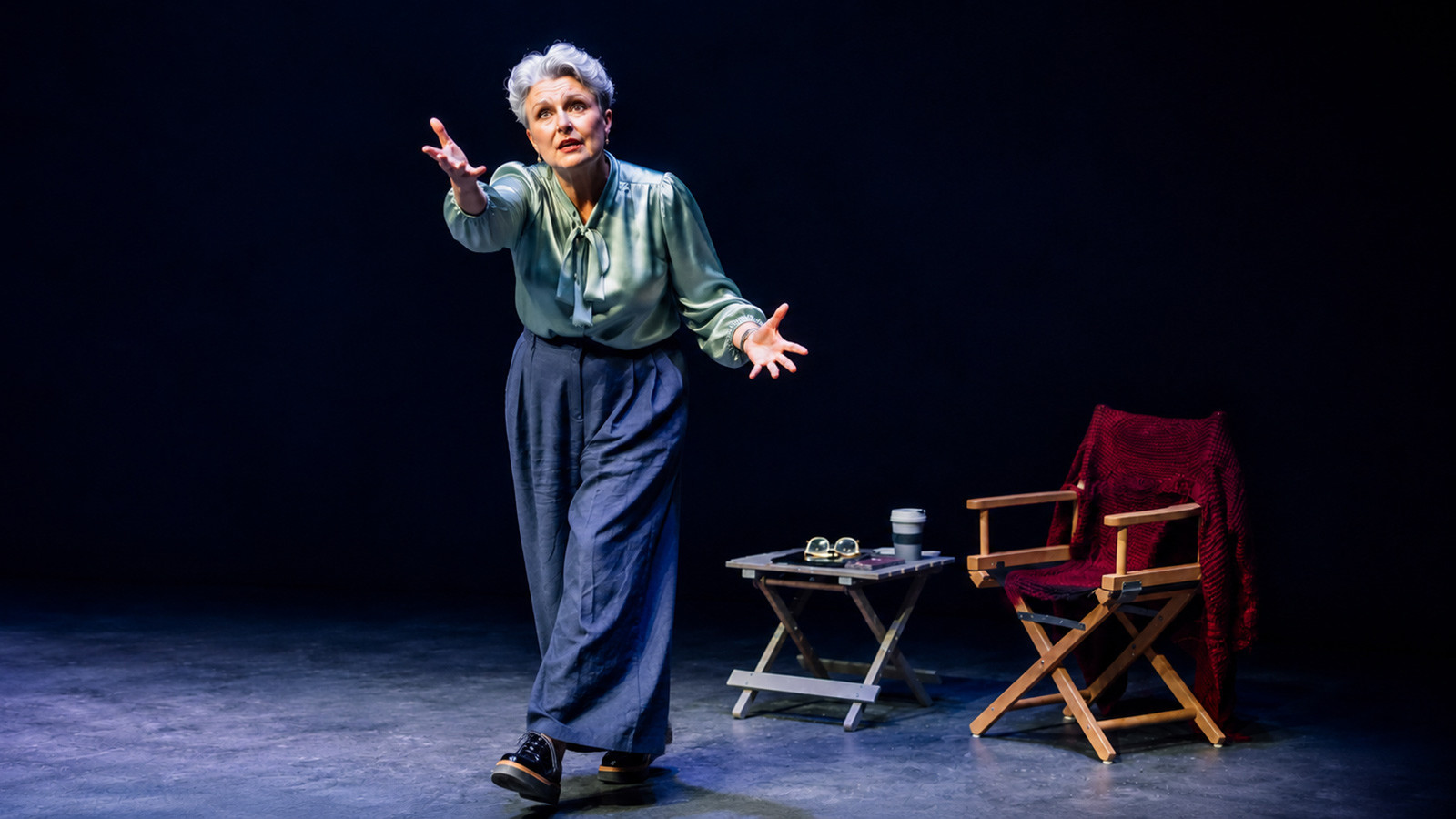
Ambiguous Proposition opens with a curious fact about killer whales. Older females continue protecting their adult sons long after those sons should be capable of looking after themselves. Margaret Woods finds the comparison amusing, but it gradually becomes the governing image of writer and co-director Shona Newmark’s intelligent and unsettling one-woman play.
Margaret has spent her professional life as an employment tribunal judge, weighing evidence and deciding which version of events should be believed. She takes considerable pride in her judgement, her command of the law and her ability to remain objective. That certainty begins to collapse when her 25-year-old son Bradley is accused of sexually harassing a colleague. Her efforts to intervene gradually turn the professional spotlight back upon her, placing her own judgement, impartiality and position under scrutiny.
Everything reaches us through Margaret. As the performance unfolds, it gradually becomes clear that we are not watching a tribunal drama in which those involved present competing accounts of what happened. We are watching Margaret receive fragments of information and attempt to arrange them into a case, despite being a mother who has already decided that her son must be protected.
The allegations include staring and following at work, physical contact in a shared kitchen and sexual remarks made during a work-related party. Bradley’s responses are thin and sometimes troubling. He cannot remember important details, accepts that some incidents could have been perceived as Chloe describes them and refuses to call her a liar. Neither Chloe nor any independent witness appears, and we are not shown messages, recordings or other evidence through which her account might be tested.
A reliable judgement about whether Bradley harassed Chloe is therefore impossible. The production deliberately withholds the material that would allow the audience to reach one. What we can examine is Margaret’s handling of the incomplete evidence she possesses. She labels Chloe manipulative, attributes the complaint to a failed attempt at promotion and repeatedly insists that Bradley is a good boy. The killer-whale comparison consequently becomes far more than an opening joke. Margaret’s profession requires her to weigh facts, while her maternal instinct demands that she protect her son.
Newmark strengthens this contradiction by showing Margaret insist that an unrepresented claimant provide precise details of dates, people and events. When Bradley cannot provide equivalent information, she begins filling the gaps herself. She believes she is examining his account, but she is increasingly coaching it towards the answer she wants.
Ambiguous Proposition is a play for audiences who enjoy watching a legal mind at work, and then watching that mind fail to remain impartial when the case concerns her own son. The questions it leaves hanging are the point.
Newmark practised as an employment lawyer for more than 30 years, and that experience gives the play considerable authority. The legal framework is explained without assuming that the audience already understands it, but it is never merely decorative. It becomes part of Margaret’s emotional armour and demonstrates how professional knowledge can be used both to illuminate evidence and to reshape it around a desired conclusion.
The opening passages require close attention as names, relationships and legal concepts arrive quickly. However, the detail flows well in performance and becomes clearer as successive layers are revealed. Names are repeated with conspicuous regularity, but this serves a practical purpose. With several important characters remaining unseen, the repetition helps Bradley, Chloe, Nigel, Justin and Beatrice become fixed in the audience’s mind without the assistance of different actors or faces.
Hilary Cordery gives a commanding and carefully controlled performance as Margaret. Herself a former employment lawyer, Cordery handles the terminology with an unforced fluency, but her achievement goes beyond making the legal language sound convincing. She is entirely believable as an employment tribunal judge who has spent years imposing order upon complicated human behaviour, weighing competing accounts and expecting her analysis to command the room. Her composed delivery allows the legal detail to flow naturally, while a dry vein of humour keeps Margaret engaging even when her confidence becomes abrasive.
The strength of Cordery’s performance becomes increasingly apparent as Margaret’s professional composure begins to fail. She initially tries to process every difficulty analytically, arranging conversations, allegations and relationships as though they were evidence before her tribunal. Her distress is intensified by Bradley’s apparent reluctance to defend himself. He provides his mother with little clear information, resists appealing and appears, from Margaret’s perspective, to have surrendered before the fight has begun.
For a woman whose instinct is to question, analyse and construct a case, his withdrawal leaves her trying to provide answers that he either cannot or will not give. Yet the more determinedly she builds his defence, the more Bradley believes she is asking him to reshape the truth. Cordery holds both sides of that conflict convincingly. As the pressure surrounding her son intensifies and Margaret’s own professional position becomes less secure, the emotion beneath her reasoning increasingly breaks through. By the final part of the performance, she is losing the control upon which she has built her identity. Her growing distress is especially effective because it contrasts so strongly with the composed and authoritative woman established at the beginning.
Bradley and Chloe are present only through Margaret’s recollections and quotations. Cordery gives these absent figures a sense of life through subtle changes in rhythm and emphasis, without turning them into exaggerated impersonations. Even so, they remain people as Margaret chooses to present them. That restriction is crucial because it prevents the audience from trying the allegation independently and keeps attention upon the reliability of the person telling the story.
Margaret’s frequent swearing punctures her judicial formality and gives the production a welcome vein of dark humour. It exposes the private woman beneath the professional position and increasingly functions as a measure of the pressure building behind her controlled exterior.
Other demands involving Margaret’s ageing father, her brother Justin and her strained relationship with her husband Nigel broaden the play beyond the central allegation. They reveal someone capable of examining other people’s responsibilities far more readily than her own. These strands also increase the sense that Margaret is losing control of several parts of her life at once, even as she tries to reduce every problem to something that can be analysed and managed.
Her deteriorating relationship with Beatrice, a regional judge she has known for years and initially regards as a friend, creates a parallel professional crisis. Margaret approaches her with little more than a feeling that Bradley may be facing trouble. Beatrice requests a draft report, subsequently sends it “upstairs” and tells Margaret to step aside temporarily. When Margaret calls her a friend, Beatrice corrects her to “work colleague”.
The individual moments are sharply observed, particularly Beatrice’s habit of placing Margaret’s name at the end of her pronouncements and Margaret’s furious response to being treated as a professional liability. However, the sequence is compressed. We neither see what Margaret placed in the report nor hear enough of Beatrice’s reasoning before the matter is escalated. As a result, the collapse of their friendship feels asserted rather than fully earned.
The irony nevertheless works. Margaret seeks the sympathy of a friend but receives the response of a regional judge confronted by a possible conflict of interest and potential reputational damage. Beatrice also removes Margaret from the professional space in which she feels heard, respected and in control, contributing to the emotional unravelling that Cordery charts so effectively.
Newmark and co-director Kay O’Dea keep the staging restrained. A director’s chair, a small folding table and a few personal objects are sufficient to create Margaret’s world. The tablet she consults repeatedly becomes a natural extension of her professional habits, reinforcing her need to research, record and impose order upon what is happening. The uncluttered setting places the full weight of the evening upon Cordery, a responsibility she carries with impressive assurance.
Music played an important role in framing the performance and marking the transitions between scenes. Louis Armstrong’s What a Wonderful World accompanied the opening, recurring cello passages created welcome pauses between sections, and Don’t Fear the Reaper supplied a suitably wry closing note. The interludes gave the audience time to absorb each new layer of Margaret’s account. Lighting and sound technician Echo Aldhous handled the music, telephone sounds and recorded courtroom cues cleanly and unobtrusively, supporting the rhythm and momentum of Cordery’s sustained solo performance.
Its legal detail, dark humour and exploration of maternal loyalty make Ambiguous Proposition particularly rewarding for audiences who enjoy intellectually driven, character-led theatre and questions that resist a simple answer. It is a one-woman play that argues rather than resolves, deliberately leaving the allegation unsettled when the house lights return.
That lack of resolution may frustrate those expecting a final verdict, but a neat answer would undermine the uncertainty upon which the play is built. We cannot determine exactly what happened between Bradley and Chloe. We can, however, recognise what happens to Margaret when her professional principles collide with the person she most wants to protect.
This is an absorbing and thought-provoking production. Although the Beatrice strand moves too quickly for the breakdown of their friendship to acquire its full dramatic weight, the legal material flows clearly and the deliberately restricted perspective keeps the ethical questions focused upon Margaret’s judgement. Cordery’s accomplished performance gives the evening its human weight, moving convincingly from formidable professional assurance towards genuine emotional distress. Ambiguous Proposition does not ask only whether harassment took place. It asks what happens to judgement when love has already decided the answer.
Meet the Company
Hilary Cordery
MARGARET WOODS
An award-winning actor and director with a long association with Bromley Little Theatre, where she has performed, directed and served as Chair of the Board. Her roles include Helene Hanff in 84 Charing Cross Road, Amanda in The Glass Menagerie and Bev/Kathy in Clybourne Park. A former employment lawyer, she brings first-hand professional insight to the role of Margaret Woods.

Shona Newmark
WRITER AND CO-DIRECTOR
A former senior employment solicitor and partner with more than 30 years’ experience, Shona advised on complex workplace disputes, discrimination and misconduct allegations. She now channels that expertise into playwriting. Ambiguous Proposition draws directly on her experience of real-world sexual harassment cases, and she has donated all her fees from the work to date to LawCare, the mental health charity for the legal sector.

Abigail Moss
PRODUCER
A producer, actor and arts leader, Abigail has several decades of experience spanning theatre, communications and organisational management. Her career has included senior executive posts and nine years as Director of Strategy for Children and Young People at Arts Council England, alongside work as a teacher, performer, tour booker and theatre administrator. She attended Cambridge University, trained at ALRA and produces Ambiguous Proposition for Miller Moss.
Cast & Creatives
- Showing: Sunday 13th September 2026 at 5pm and 7.30pm
- Venue: The Old Bakehouse Theatre, 11 Blackheath Village, Blackheath, London SE3 9LA
- Buy Tickets: https://www.millermoss.co.uk/ambiguous
- Running Time: Approximately 1 hour 10 minutes, followed by an after-show discussion
- Production: Wait, What? in association with Miller Moss
- Writer & Co-Director: Shona Newmark
- Co-Director: Kay O’Dea
- Lighting Designer: Simon Tyrell-Lewis
- Lighting & Sound Technician: Echo Aldhous
- Producer: Abigail Moss of Miller Moss
- Marketing: Nick Miller of Miller Moss
- Devised By: InHouse Theatre Productions - https://www.instagram.com/inhousetheatreproductions/
- Marketing and Social Media: Honor Forrester
- With Thanks: Age Exchange, Bromley Little Theatre and Blackheath Community Theatre
- Cast:
An intelligent and absorbing study of judgement and maternal loyalty
Summary
Shona Newmark’s one-woman play examines an employment tribunal judge whose professional impartiality fails when her son is accused of sexual harassment. Hilary Cordery gives a commanding, emotionally layered performance, while the legal detail, dark humour and unresolved questions create an absorbing evening, despite a compressed professional subplot.


Add comment