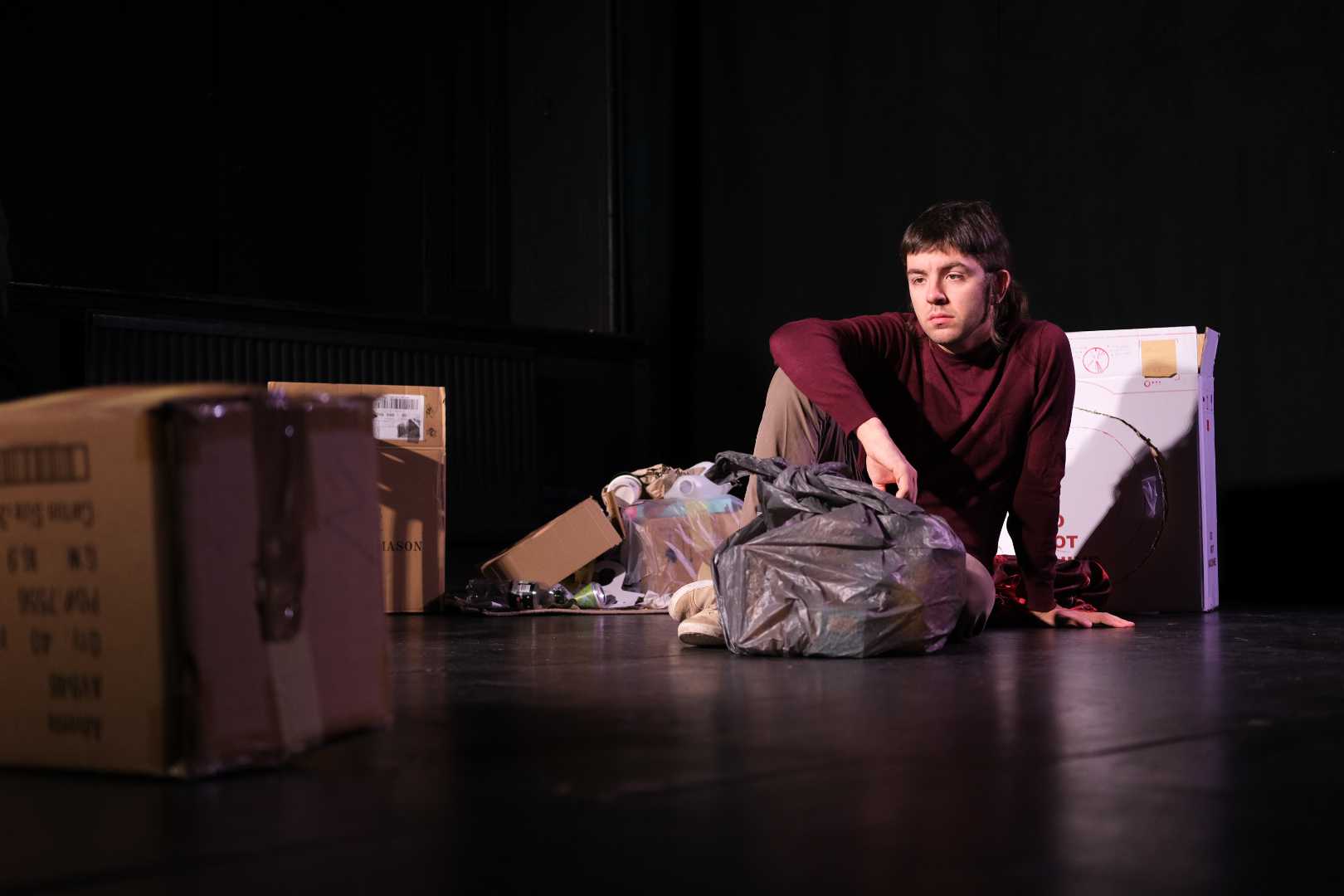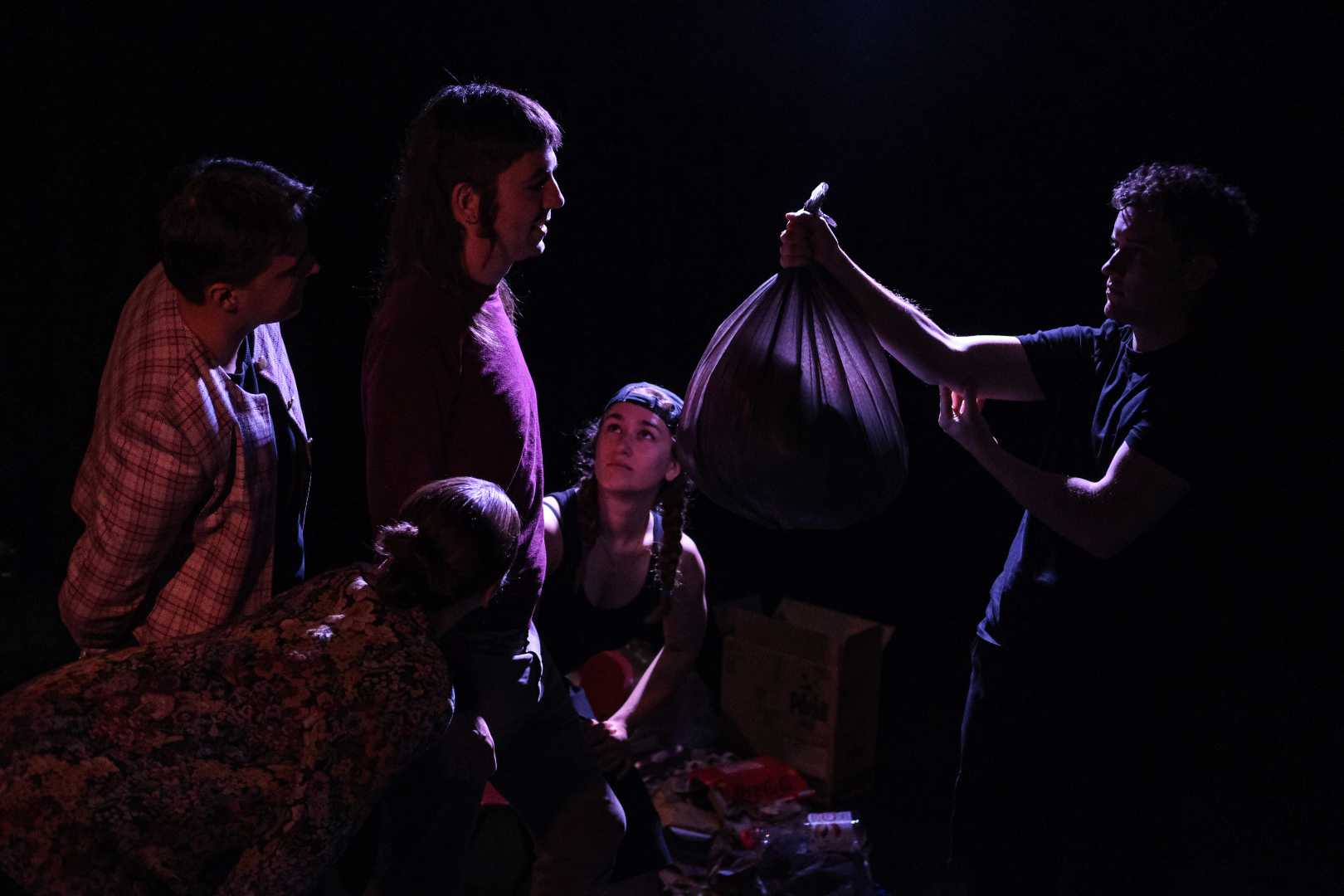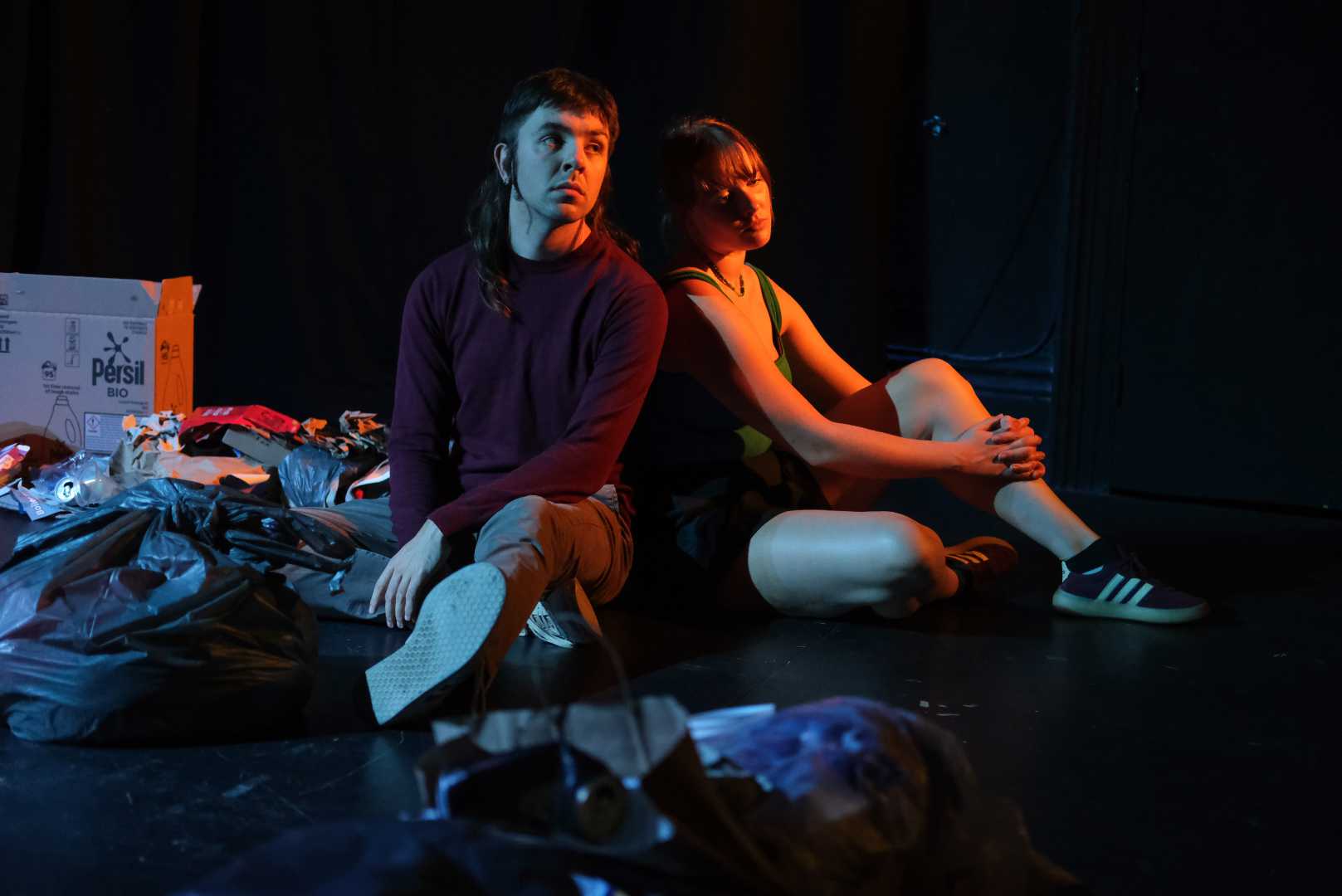
There is a black bin bag at the centre of Have You Took The Bins Out?, and Orson Bourne’s debut full-length play understands how much emotional weight such an ordinary object can carry. It is luggage, rubbish, memory, shame and inheritance. As bags accumulate outside a young couple’s new home during a bin strike, the discarded material in the street begins to mirror everything Man has spent years trying to bury.
Produced by Lamp Light Theatre Company and directed by Emma McAllister, the play opens with the bright rhythm of an exaggerated domestic sitcom. Man and his girlfriend Zsazsa have moved into a small rented house in the Midlands and are attempting to assemble the furnishings of a respectable adult life. There are moving boxes, new appliances, interfering neighbours, difficult relatives and arguments over the proper pronunciation of “charcuterie”. Then Zsazsa announces that she is pregnant, and the cheerful disorder begins tightening into something far darker.
Bourne, who has spoken about growing up in foster care, writes from a place of clear personal urgency. Man has escaped the care system, found a girlfriend and acquired the beginnings of a home, yet he cannot quite believe that any of it belongs to him. Every step towards permanence stirs memories of being moved, assessed and told to begin again. His desire to become a father is therefore both hopeful and frightening: an opportunity to build the family he never had, and a test he is terrified of failing.
As Man, Orson Bourne gives the production its exposed emotional centre. He initially plays him with restless, boyish humour, forever making jokes, dreaming about furniture and performing confidence whenever the conversation edges towards anything painful. The comedy gradually reads as a survival mechanism. As pressures accumulate, Bourne lets the charm fray, revealing the frightened child still operating beneath the adult surface. His performance becomes increasingly raw without losing the vulnerability that keeps Man sympathetic even when his behaviour becomes volatile.
Eloise Thody brings sharp comic timing and emotional resilience to Zsazsa. She is not simply the patient girlfriend waiting for Man to tell the truth. Her own history, privilege, mistakes and fears complicate the relationship, and Thody captures both the affection holding the couple together and the exasperation pulling them apart. Their early scenes have genuine warmth, which makes the later fractures feel consequential rather than mechanically plotted.
The arrival of Zsazsa’s parents turns the play towards full domestic farce. Frank Cawley plays Gertrude with grand, acidulous superiority, policing vocabulary and manners while barely concealing her disdain for Man. At the performance reviewed, director Emma McAllister stepped into the role of Nicholas as an announced substitution, performing with the script in hand. She handled the emergency change with composure and kept the increasingly crowded dinner sequence moving with assurance.
The gender-switched parental casting adds another layer of heightened comedy. Once friends, relatives, former lovers and neighbours converge on the house, secrets begin erupting in rapid succession. The sequence is one of the evening’s funniest stretches, but it also acts as the hinge between the play’s sitcom opening and its emotional aftermath. Rather than ending with the farcical explosion, Bourne allows the consequences to continue spreading through the second half.
Grace Boag-Matthews gives Miz Bakewell a gloriously outsized presence, sweeping into the new home with Texan piety, petitions and moral certainty. Her comic confidence is well judged, but the performance also allows glimpses of something more troubled beneath the neighbourly interference. Anna Vera Derschmidt brings welcome directness to Charlie, Man’s longstanding friend, while Jay-Jay Alexander initially presents Harvey as a swaggering, jack-the-lad figure whose plumbing metaphors and sexual confidence earn laughs before his presence becomes more threatening.
Alexander later appears within the production’s shifting ensemble of carers, children and officials. The doubling allows a comic figure from the present to acquire the shadow of someone from Man’s past, although the transition is not always immediately easy to decode. This uncertainty is partly purposeful: the production repeatedly allows present relationships and childhood memories to bleed into one another.
The domestic action is interrupted by stylised ensemble sequences that initially seem deliberately cryptic. Social workers, police officers, carers and other authority figures merge into a shifting chorus of institutional voices, replaying assessments, removals and fragments of Man’s childhood. Their meaning becomes clearer with each recurrence, until past and present begin to overlap and the home he is trying to build feels increasingly vulnerable to the machinery that once controlled his life.
These interludes are among the production’s most distinctive achievements. Language is broken into forms, reports, categories and reassuring professional phrases that become sinister through repetition. Different adults may have delivered each judgement during Man’s childhood, but memory has compressed them into one impersonal system. The repeated emphasis on protocols and completed boxes captures the gulf between administrative process and the emotional reality of the child being moved.
The ensemble works hard across these rapidly changing identities. Thody, Boag-Matthews, Cawley, Alexander and Derschmidt move between principal characters and social workers, carers, children and officials, creating the sense that Man’s history is always waiting just beyond the walls of his new home. Producer George Bird also joins the final sequence as a social worker, briefly stepping from the audience into the action.
Jasmine Hoi Ching Tom’s lighting helps distinguish the lively domestic comedy from these more abstract and unsettling passages. The black-box room above the welcoming Drayton Arms pub places the audience close to the accumulating clutter, giving the production an appropriately compressed atmosphere. On an exceptionally hot and humid evening, the upstairs space became uncomfortably warm, but the company maintained its pace and energy throughout.
Bourne’s writing is ambitious and densely packed, sometimes almost to a fault. Particularly early on, names, histories and relationships are referred to before the relevant characters have been properly established. Later revelations usually prompt the audience to reassess and clarify what has come before, which can be satisfying, but there are moments when the story is already accelerating while the mind is still arranging its family and friendship map.
A late symbolic sequence involving a baby, the black bag and the washing machine is similarly powerful but initially difficult to interpret. The infant appears to represent Man himself as a neglected child, rather than his own newborn baby, and the washing machine becomes an image of cycles, stains and his desperate desire to cleanse or destroy the past. The meaning emerges retrospectively, but the immediate staging leaves enough uncertainty that the scene may momentarily be read more literally than intended.
That slight confusion does not diminish the potency of the image. Man is confronted with the abandoned child he still carries and attempts to force that child through yet another violent cycle. The final passages suggest that leaving care is not the same as escaping its psychological consequences. A person may move into a new house, become a parent and build an adult identity, while still expecting the next knock on the door to remove everything again.
Have You Took The Bins Out? is a raw, energetic and imaginative debut. Its abundance of ideas occasionally makes the storytelling harder to follow than necessary, but the same unruliness gives it theatrical life. It begins by inviting the audience to laugh at an eccentric household and gradually reveals why laughter is one of Man’s most important forms of protection.
Lamp Light Theatre Company’s first full-length production marks Bourne as a writer with something urgent to say about the adult aftermath of care. Funny, bruising and unafraid of emotional mess, the play asks what it means to create a secure home when every earlier home taught you not to unpack.
Cast & Creatives
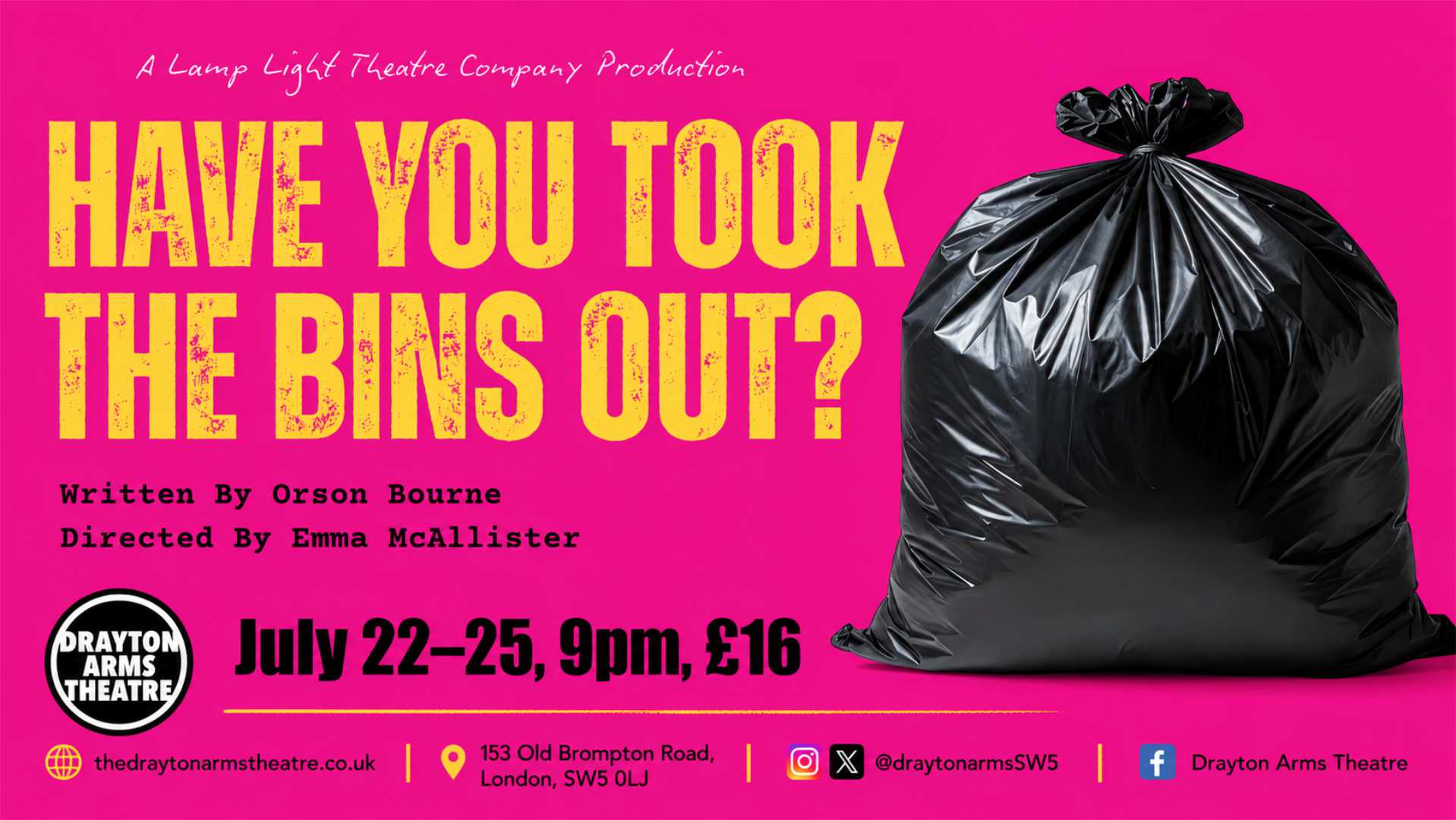
- Showing: 22nd – 25th July 2026, 9pm
- Venue: Drayton Arms Theatre, 153 Old Brompton Road, London SW5 0LJ
- Buy Tickets: https://www.ticketsource.com/lamplighttheatrecompany/have-you-took-the-bins-out/e-jplbao
- Writer: Orson Bourne
- Director: Emma McAllister
- Producer: George Bird
- Production: Lamp Light Theatre Company
- Photography: Dexter Robinson
- Cast:
Eloise Thody as Zsazsa, Social Worker and Student Welfare Officer
Grace Boag-Matthews as Miz Bakewell, Social Worker, Child, Policewoman and Waiter
Frank Cawley as Gertrude, List, Child, Carer and Social Worker
Jay-Jay Alexander as Harvey, Carer, Child and Taxi Driver
Anna Vera Derschmidt as Charlie, Social Worker, Carer, Child and Headteacher
Emma McAllister as Nicholas (announced substitution), Policeman, Nurse, Social Worker and Computer
George Bird as Final Social Worker
A raw and ambitious debut about care, class and the fragile idea of home
Summary
Orson Bourne’s Have You Took The Bins Out? begins as an eccentric domestic comedy before darkening into a raw and ambitious exploration of care experience, class, parenthood and buried trauma, performed with energy by Lamp Light Theatre Company.


Add comment