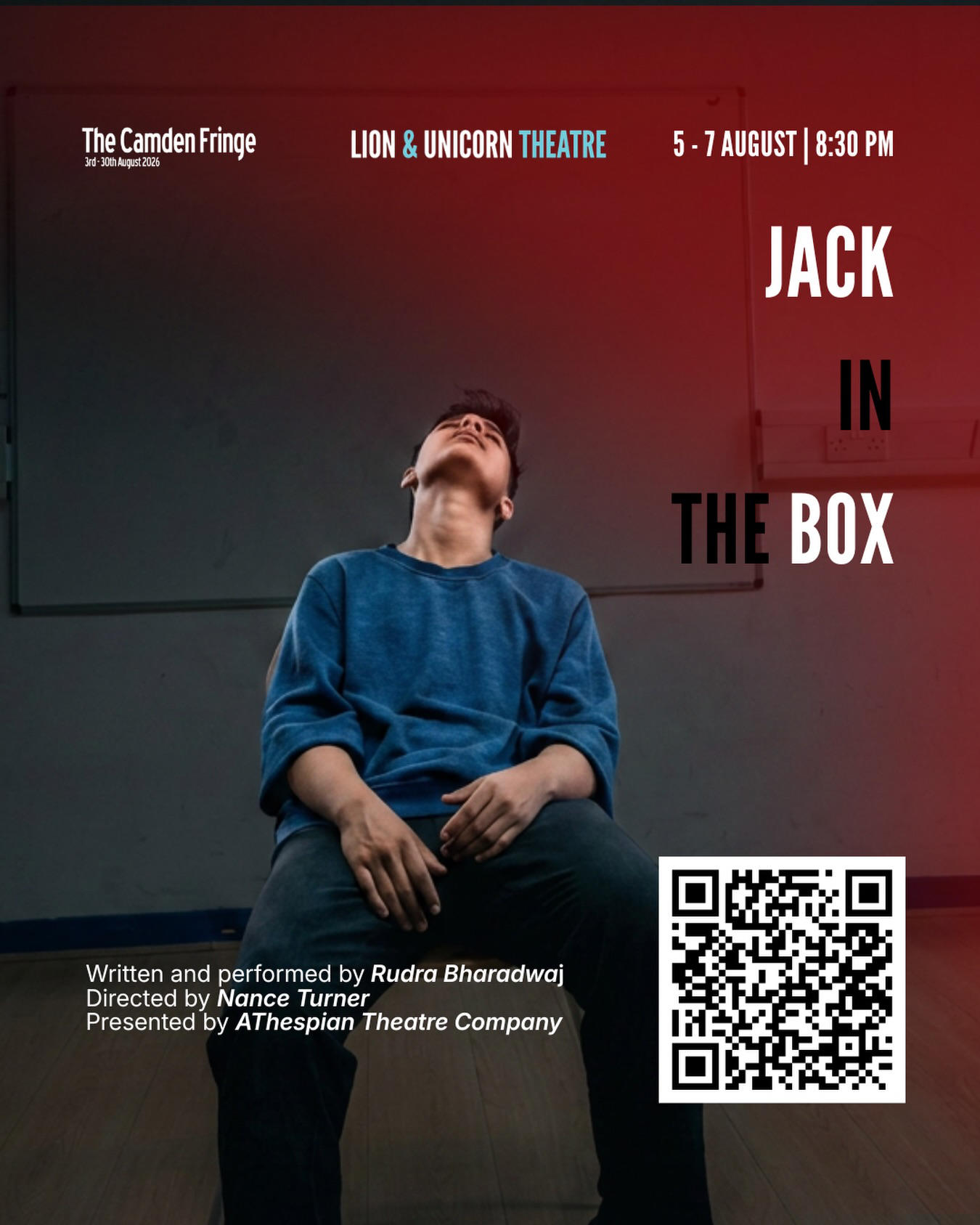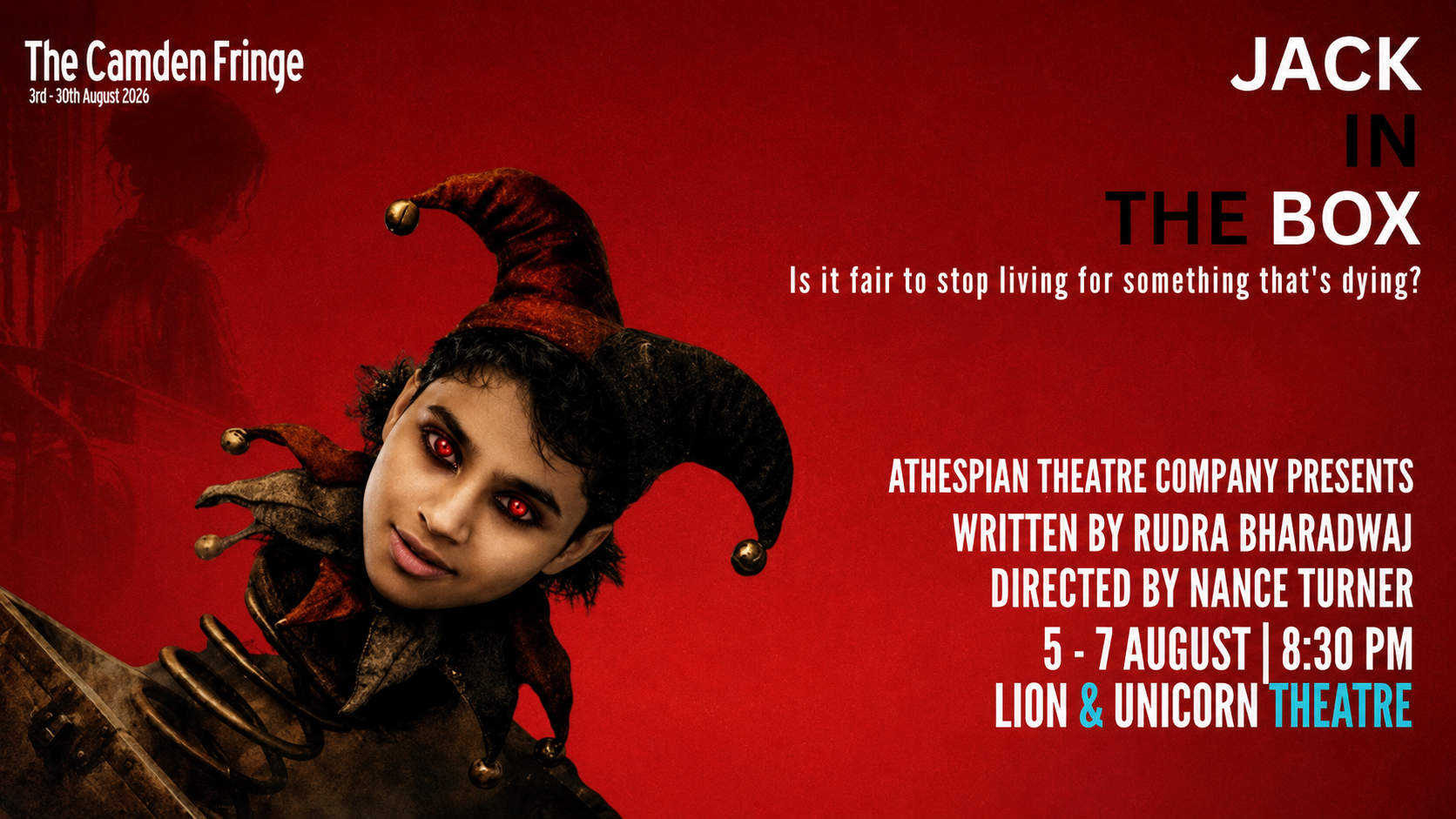
In the intimate black-box space of the Lion & Unicorn Theatre, Jack in the Box places its audience uncomfortably close to one person’s slow unravelling. Written and performed by Rudra Bharadwaj and directed by Nance Turner, this solo play is intense, psychologically charged and unafraid of the thoughts people are not supposed to say out loud.
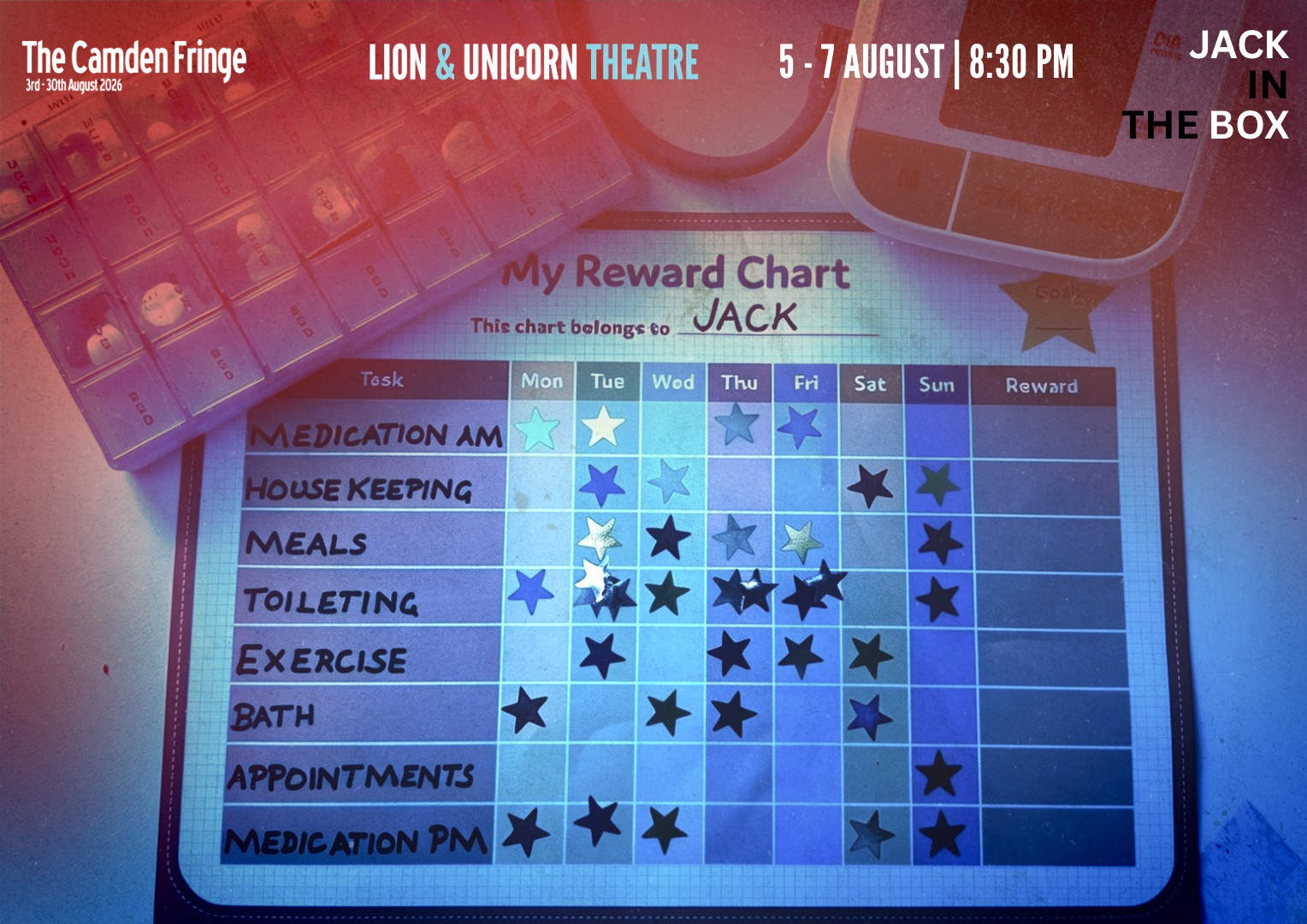
At its centre is Jack, an exhausted unpaid carer whose life has narrowed to medication, nappies, bells, charts and interrupted sleep. Sixteen months earlier, a doctor gave Jack’s mother a prognosis of four to six months. She is still alive, but Jack’s own life has gradually been pushed beyond the boundaries of the room. Jobs, relationships and even therapy have fallen away as caring has taken over.
Bharadwaj gives a powerful and assured solo performance, appearing entirely at ease with the considerable demands of holding the stage alone. Their voice is used to particularly good effect, expressive and wide-ranging as Jack moves between humour, frustration, tenderness, anger and mounting desperation. The emotional transitions feel natural rather than imposed. This is also a strongly physical performance. Bharadwaj uses the space confidently, enacting Jack’s experiences rather than merely recounting them, while movement sometimes gives way to sudden frozen or crouched stillness as the pressure closes in. Even Jack’s unseen mother acquires a convincing presence through Bharadwaj’s changes of voice and reactions.
Routine becomes both Jack’s means of coping and the mechanism through which their autonomy disappears. Pills, washing, lifting, feeding and cleaning provide structure, but the same actions must be performed again and again. The bell calling Jack back to their mother comes to symbolise considerably more than a request for assistance. Its chime becomes an audible tether, repeatedly pulling Jack back into a role from which there seems to be no escape. Jack’s time and attention no longer entirely belong to them.
The production pushes this further through “Motherland”, a warped theme park constructed from Jack’s caregiving life. Jack becomes a strangely cheerful ride operator, introducing attractions built from the very routines that are destroying them. There is The Bell, The Lonely Lane and, most powerfully in performance, The Loop. In the latter, Bharadwaj repeats the same sequence of turning, washing, checking and feeding with increasing speed. What begins as practical caregiving acquires an almost ritualistic momentum, the accelerating repetition making Jack’s exhaustion physically palpable. The routine is no longer simply something Jack performs; it feels as though Jack has become trapped inside it.
Humour surfaces intermittently without ever defining the piece. Bharadwaj draws genuine laughter from some of Jack’s observations, while elsewhere the response is more nervous, a release valve for an audience confronted with something uncomfortable. Those lighter moments never turn Jack in the Box into a comedy. Instead, they make Jack more recognisably human and give the darker passages greater weight when they arrive.
One of the most powerful shifts comes when the play reaches backwards into Jack’s childhood. A memory of a theme-park visit initially carries the excitement of a child desperate for their mother to see them enjoying a ride, before that happiness is abruptly shattered when the mother slaps Jack in front of everyone. The episode gives Jack a history beyond the immediate pressures of caring and helps us understand why love, obedience, resentment and obligation have become so tightly entwined. It does not excuse what Jack will later do, but it makes the emotional inheritance behind their behaviour much harder to dismiss.
The mother’s subsequent apology arrives with a lollipop and the implication that Jack will understand her actions one day. The lollipop becomes a quietly devastating motif when it returns later. Jack, desperately trying to escape patterns imposed on them since childhood, begins unconsciously to reproduce one of those same patterns. The past has not disappeared; it has simply changed costume.
Turner’s direction handles the movement between present-day caregiving, childhood memory and the heightened world of Motherland with clarity. The different timeframes are integrated without becoming confusing, allowing Jack’s past and present to bleed into one another while the emotional thread remains easy to follow. The pacing across the hour is well judged, particularly for a solo performance that must sustain its momentum without another actor on stage.
There is, however, room for slightly more breathing space between some scenes. Some of the scene transitions are marked by very quick fades to black, and there are moments when a slightly longer pause in darkness would allow the emotional weight of what has just happened to settle more fully. In a production built around such intense psychological shifts, an extra beat of stillness could make those transitions feel even more profound.
After a second stroke leaves Jack’s mother largely non-verbal and still more dependent, even her repeated vocalisation begins to resemble the bell, another summons from which Jack cannot switch off.
The black-box setting becomes especially effective as the play moves towards its darkest passage. Jack finally sees the possibility of reclaiming some part of their life through a job interview, only for their mother’s needs to intrude once again. What follows is shocking and deeply uncomfortable. The proximity of performer and audience gives the scene an almost macabre intimacy, making us feel less like spectators than witnesses to something going terribly wrong at arm’s length.
Bharadwaj retains Jack’s vulnerability even here. That is crucial. The moment is made more disturbing by the uncertainty over whether Jack fully comprehends the extent of their actions while carrying them out, so consumed have they become by the immediate need to silence one interruption and secure one small piece of independence. The mother’s response only deepens the unease, turning what could have been played simply for horror into something painfully entangled with care.
This moral uncertainty is where Jack in the Box becomes most interesting. It refuses to tidy Jack into victim, martyr or monster. The exhaustion does not absolve their behaviour, but neither does the production allow us to ignore what has brought them there. Jack’s loss of autonomy has taken place gradually, through thousands of apparently ordinary acts of care, while relatives and outsiders see the work being performed without necessarily seeing the person doing it. In Motherland’s Lonely Lane, praise such as “You are so strong” becomes less comforting than it first sounds.
The result is a play in which compassion and alarm are held in uncomfortable proximity. Love has become labour, labour has become obligation, and obligation has begun to shade into harm. Yet Jack in the Box resists offering a neat moral verdict. Instead, it leaves us confronting the frightening point at which devotion can begin to distort into control.
As a Camden Fringe solo show, Jack in the Box is bruising, intimate and deeply human, finding theatrical life in a subject too easily flattened into sentiment or public-service language. Bharadwaj’s powerful central performance holds together a sharp and uncomfortable hour in which care is rendered not as saintliness, but as pressure, repetition, memory, loss of autonomy and damage.
Performer
Rudra Bharadwaj
JACK / WRITER & PERFORMER
Rudra Bharadwaj is a London-based actor, writer and theatre-maker, and the founder of AThespian Theatre Company. They completed an MA in Acting at East 15 Acting School in 2023, following earlier training at Dramads Theatre Company in India. Recent work includes playing Doug in Gruesome Playground Injuries at the Golden Goose Theatre and serving as Movement Director for See It Say It… Salted! at Camden Fringe 2025. Jack in the Box is AThespian Theatre Company’s first solo production.
Cast & Creatives
- Showing: 5th – 7th August 2026
- Venue: Lion & Unicorn Theatre, 42–44 Gaisford Street, Kentish Town, London NW5 2ED
- Buy Tickets: https://camdenfringe.com/events/jack-in-the-box/
- Writer & Performer: Rudra Bharadwaj
- Director: Nance Turner
- Assistant Director: Jingle Jiang
- Creative Producer: Aadhya Kacher
- Presented By: AThespian Theatre Company
- Festival: Camden Fringe 2026
- Production Photography: comming soon
- Cast:
A bruising, darkly funny portrait of care pushed to breaking point
Summary
Rudra Bharadwaj’s solo play turns the relentless routines of unpaid care into an intimate and psychologically charged hour. Directed by Nance Turner, it confronts love, resentment, guilt and burnout without reducing Jack to either victim or villain.


Add comment