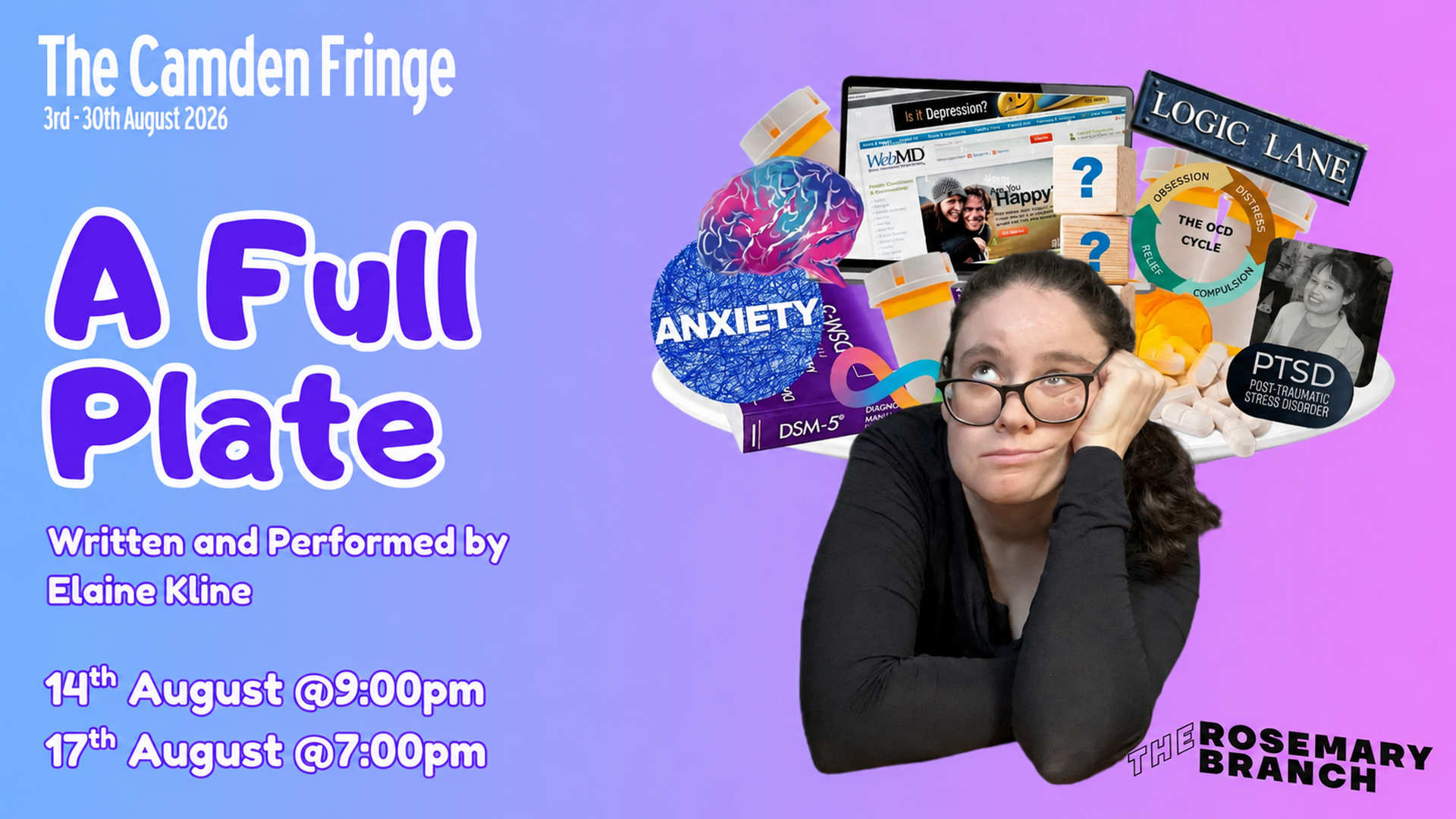
“Normal” is the first idea that A Full Plate sets out to dismantle. In this candid and frequently funny one-woman show, writer and performer Elaine Kline traces more than two decades of living with anxiety, obsessive-compulsive disorder and post-traumatic stress disorder, while examining the experiences that shaped both her mental health and her understanding of herself. It is part autobiographical testimony, part illustrated talk and part direct conversation with the audience, delivered without self-pity and with an insistence that a diagnosis can explain a person without defining the whole of them.
Kline’s story pivots on a family car accident in 2004, when she was eight years old. A routine drive to Cape Cod became the event after which nothing felt routine again. A shift into sound and an extended pause around the collision briefly moves the production into a more concentrated theatrical register. Kline recalls the split-second decision her father had to make, the injuries suffered by her family and the bewildering days that followed. Her account is most affecting when it returns to the perspective of a child: the song playing on her Walkman, discovering during a nursing-home visit that her great-grandmother wore a wig, or returning to school still bandaged while classmates asked what had happened. These sharply observed details prevent the accident from becoming merely the first item in a medical history.
The show then follows the anxiety, panic attacks and vivid flashbacks that emerged in its aftermath. Kline is a confident and personable performer whose direct-address style is informal and disarming. She holds the intimate black-box room with a clear, conversational delivery, asking the audience questions, interrupting herself with comic asides and recreating conversations with relatives, teachers and medical professionals. It takes considerable courage to expose experiences this personal to a room of strangers, but Kline remains in control of the telling, inviting empathy without asking for pity. She allows the narrative to darken, then returns to humour without trivialising what has been disclosed. Her comedy comes less from constructed punchlines than from exasperation, specificity and a willingness to acknowledge the absurdity that can exist alongside distress. The liberal use of strong language is part of that unfiltered voice, although its frequency occasionally reduces its force as comic punctuation.
Much of A Full Plate is deliberately explanatory. Kline distinguishes ordinary fear from persistent anxiety, separates obsessions from compulsions and introduces the audience to CBT and exposure and response prevention therapy. At intervals, a projector displays slides directly onto the black back wall of the room. Without the contrast of a white screen, some of the text is a little difficult to read, although Kline reads the material aloud, ensuring that nothing essential is missed. The images, lists and infographics help organise a considerable amount of information. The clearest sections connect those definitions immediately to lived experience. Her account of a panic attack makes a clinical term physical, while her description of the rituals that once governed eating, writing and handwashing demonstrates why describing someone as “a bit OCD” so badly misunderstands the condition.
This educational purpose is valuable and firmly rooted in Kline’s wish to challenge stereotypes. A Full Plate is an autobiographical monologue, and a degree of explanation is intrinsic to the form she has chosen. At times, however, the succession of definitions, diagnostic criteria and statistics makes the production feel closer to a presentation than a piece of theatre. Some pruning would allow more of the material to be dramatised rather than explained without asking the show to become something it is not. The gentler memories show how effective that can be. A teacher overhearing the young Kline singing quietly to calm herself becomes a touching account of how one small act of encouragement helped direct her towards the stage.
The emotional and dramatic stakes intensify as Kline reaches adolescence. Puberty coincides with rapidly escalating compulsions, denial and three admissions to psychiatric care within nine months. Her recollections of professionals range from profound gratitude to justified anger, including a therapist whose alarmist approach did more harm than good. The most substantial part of this story concerns the specialist residential treatment she received in Wisconsin. Kline explains the gruelling logic of exposure therapy with admirable clarity, showing why treatment could feel unbearable while also demonstrating how it enabled her to eat, write, enter a cinema and speak about the accident without being controlled by ritual or flashback.
Humour is essential in preventing these passages from becoming oppressively bleak. Stories about fellow patients restore the messy individuality of young people too often reduced to symptoms in accounts of institutional care and offer the audience welcome breathing space, although the sequence runs a little long. If Kline develops the piece further, more comic memories and positive experiences distributed across the wider story would provide greater tonal variation and make the darker moments land with even greater force. Her closing affirmation reveals a life that also contains friendship, ambition, humour and achievement; earlier glimpses of those elements would enrich the portrait. The production regains its strongest focus when Kline describes what happens after discharge: the gossip and awkward questions at school, relatives mistaking improvement for a cure, and the difficult work of continuing treatment once intensive support has gone.
That refusal of an uncomplicated recovery narrative is one of the show’s greatest strengths. Kline does not offer perseverance as a miraculous cure. She remains candid about medication, recurring anxiety and the possibility of relapse, while recognising the enormous distance travelled from the child who could not complete the ritual required to eat or drink. A later sequence, presented as her anxiety in infographics, brings the story into the present with a witty ranking of everyday triggers, unsuitable places to have a panic attack and the well-intentioned remarks that are rarely helpful.
The final movement introduces a more recent understanding of Kline’s neurodivergence and retrospectively reframes details from her childhood. It also gives the title a more literal and poignant meaning. The revelation is dramatically effective, but it arrives late and introduces another large subject with only a few minutes available to explore it. Even so, it supports the production’s central argument: labels can bring relief and recognition when they provide a language for experiences that previously looked like personal failure.
Kline closes not by presenting herself as cured, but by placing mental illness within a much larger identity. She is an actor, singer, friend and woman building a life that her younger self could scarcely have imagined. The accompanying programme’s links to mental-health resources underline the care with which she has approached potentially difficult material.
A Full Plate would benefit from some tightening, further dramatisation of parts of its clinical information and a few more moments of levity. Nevertheless, its candour, humour and specificity make it an accessible and compassionate piece of autobiographical theatre. Kline’s performance is sustained by openness and assurance. Her achievement is not simply that she has survived what she describes, but that she can look back without reducing either herself or the people around her to a collection of diagnoses.
Writer & Performer
Elaine Kline
ELAINE
Elaine Kline (she/her) is a London-based American actor, singer and theatre-maker originally from Boston. A graduate of Berklee College of Music, she completed an MFA in Acting at East 15 Acting School in 2024. Recent credits include Heim at artsdepot, Calling at Hoxton Hall, Semi-Monde at the Bridewell Theatre and The Thin Place at the Camden and Edinburgh Fringes.
Cast & Creatives
Frank, funny and informative, Elaine Kline turns a deeply personal mental-health history into an accessible solo show.
Summary
Elaine Kline brings openness, assurance and considerable courage to a deeply personal autobiographical monologue about anxiety, OCD and PTSD. Some tighter shaping and more moments of levity would strengthen the piece, but its candour, humour and specificity make it an accessible and compassionate theatrical account.


Add comment