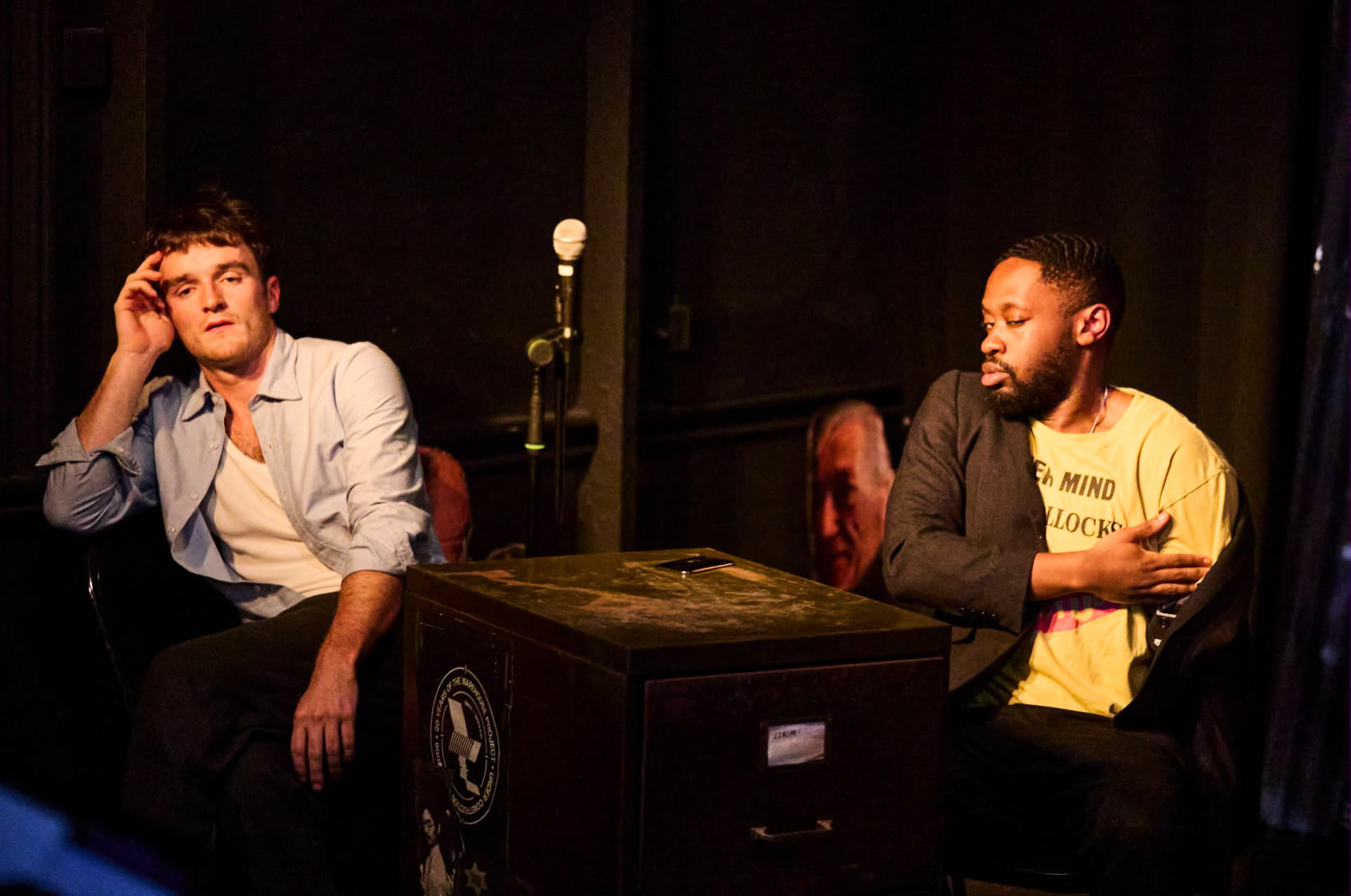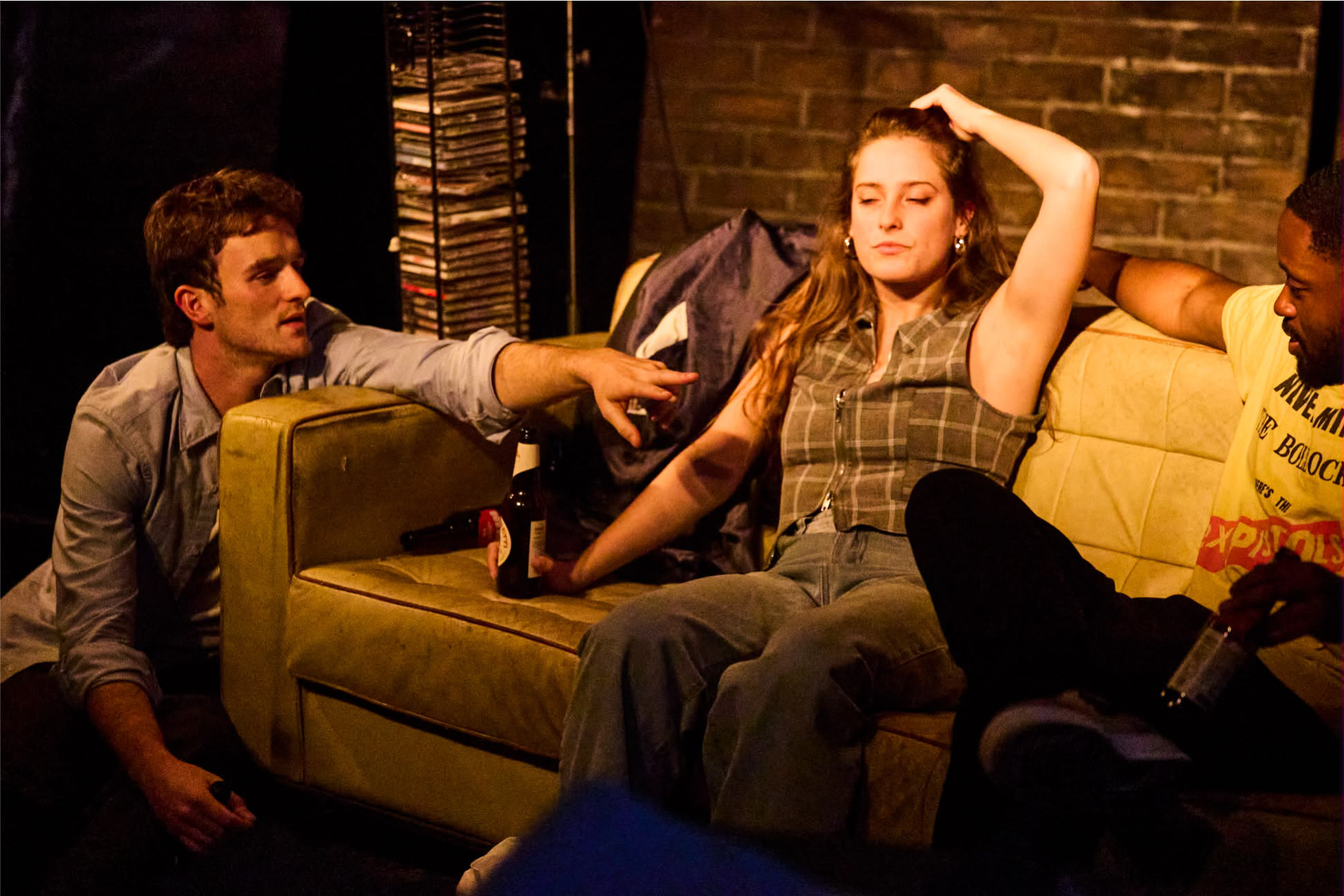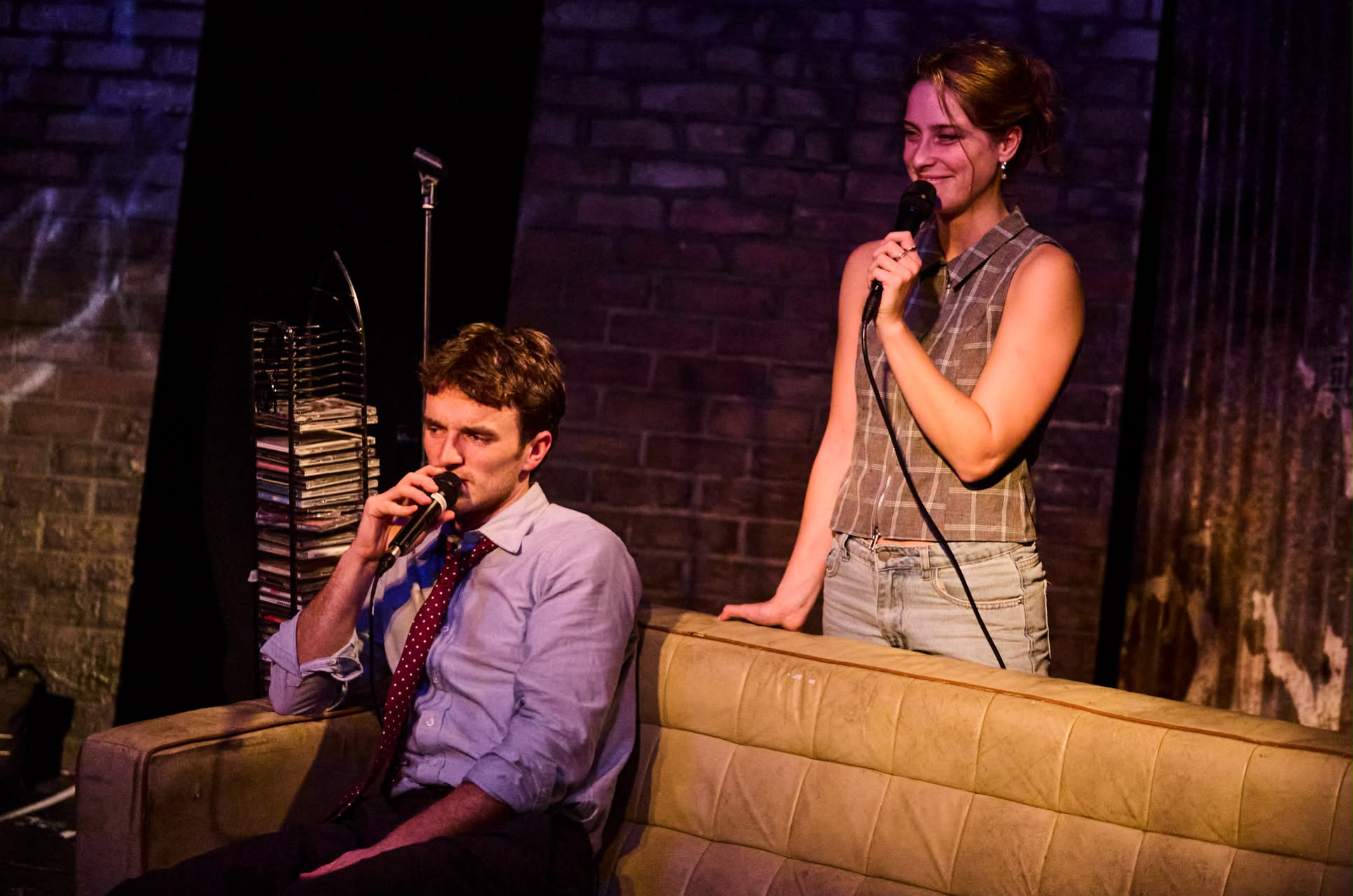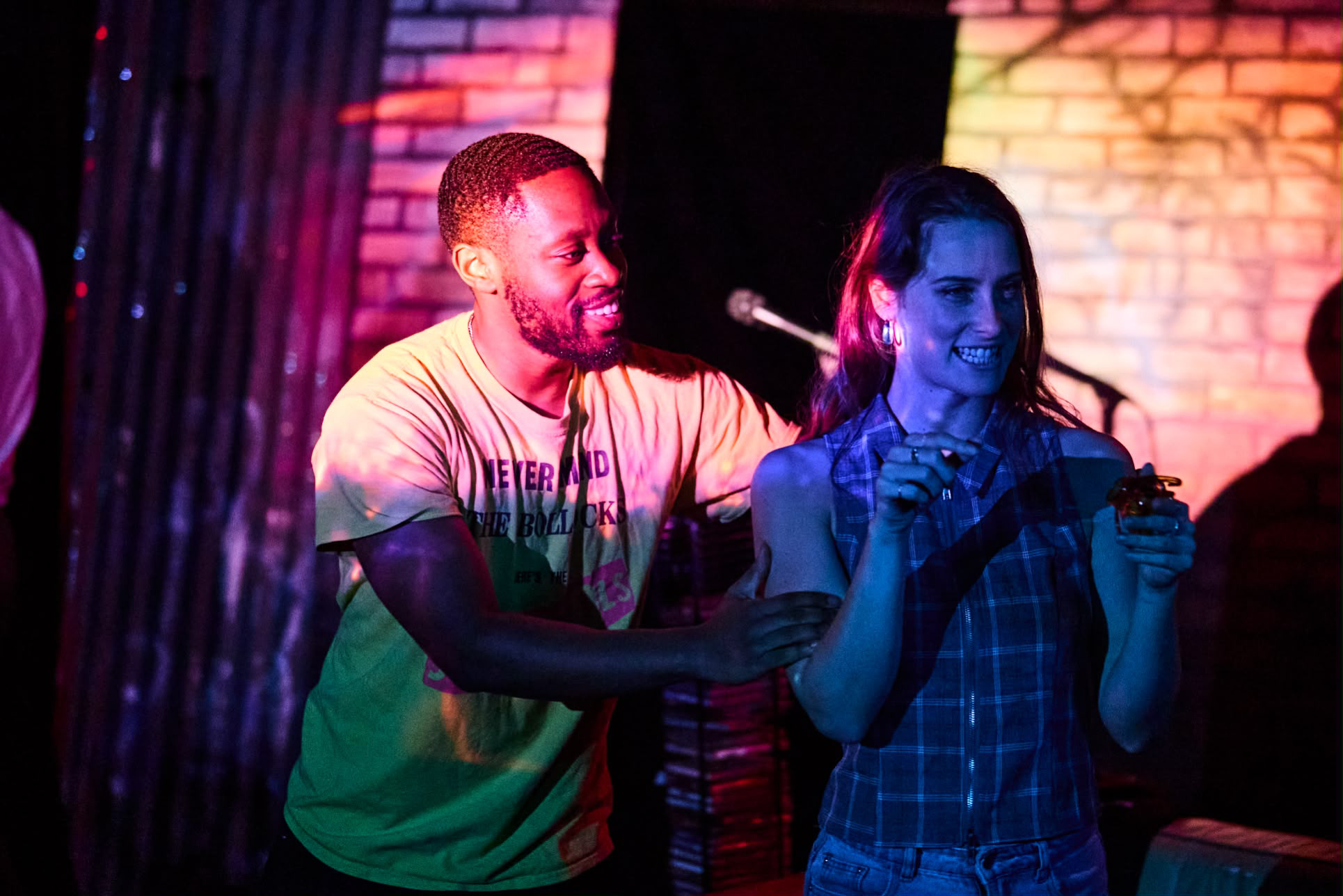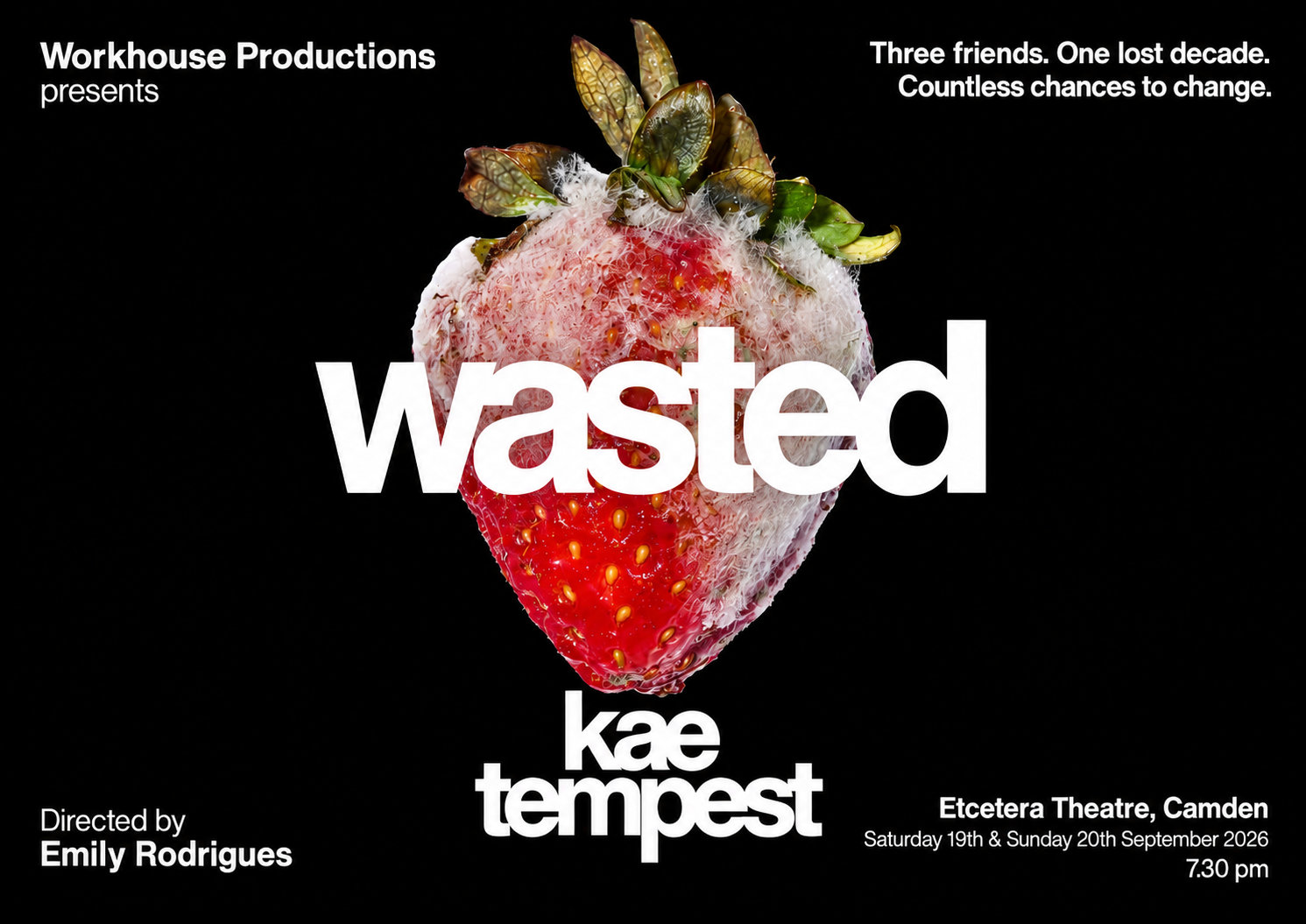
Ten years can pass remarkably quickly, particularly when the future once seemed to offer endless possibilities. In Kae Tempest’s Wasted, three childhood friends find themselves confronting the uncomfortable distance between the people they imagined becoming and the lives they now lead. Presented by Workhouse Productions at the Etcetera Theatre, under the direction of Emily Rodrigues, this exploration of friendship, grief and unfulfilled ambition combines everyday conversations with Tempest’s distinctive spoken-word poetry, finding humour and sadness in the familiar promises people make to change their lives.
Ted, Danny and Charlotte have been friends since childhood, sharing memories of parties, youthful rebellion and a time when the world seemed theirs for the taking. They reunite on the tenth anniversary of the death of their friend Tony, whose absence continues to shape their lives. Now in their mid-twenties, each is struggling with the responsibilities and disappointments of adulthood. Ted has settled into an office job and a long-term relationship, Danny continues to pursue his dreams of musical success, while Charlotte is a teacher whose enthusiasm for her profession has been steadily eroded by its everyday realities.
Tony’s death provides the occasion for reflection, but the play is concerned as much with the lives of those left behind. Their memories of him are intertwined with recollections of their younger selves, when ambitions were uncomplicated by experience and the consequences of their decisions seemed comfortably distant. Tony remains forever young, while his friends have grown older and increasingly uncertain about what they want from life.
Freddie Farrell brings a convincing mixture of humour, frustration and vulnerability to Ted, whose outwardly settled existence conceals considerable dissatisfaction. He has a steady income, a girlfriend and the security that Danny lacks, yet feels trapped by the repetition of office work and domestic routine. Farrell gives the character an engaging restlessness, allowing his complaints to spill out with comic energy while revealing the unhappiness beneath them. Ted’s affection for his friends is particularly important, and Farrell makes his concern feel genuine, even when it emerges through teasing or blunt criticism.
Ted is perhaps the most contradictory of the three. He dreams of escaping his responsibilities, yet also understands the importance of commitment and the quieter pleasures of everyday life. His observations about happiness, including the small gestures and ordinary experiences that make life worthwhile, provide some of the writing’s more thoughtful moments. Farrell handles this contrast between disillusionment and affection with sensitivity, suggesting a man who understands more about his predicament than he is prepared to admit.
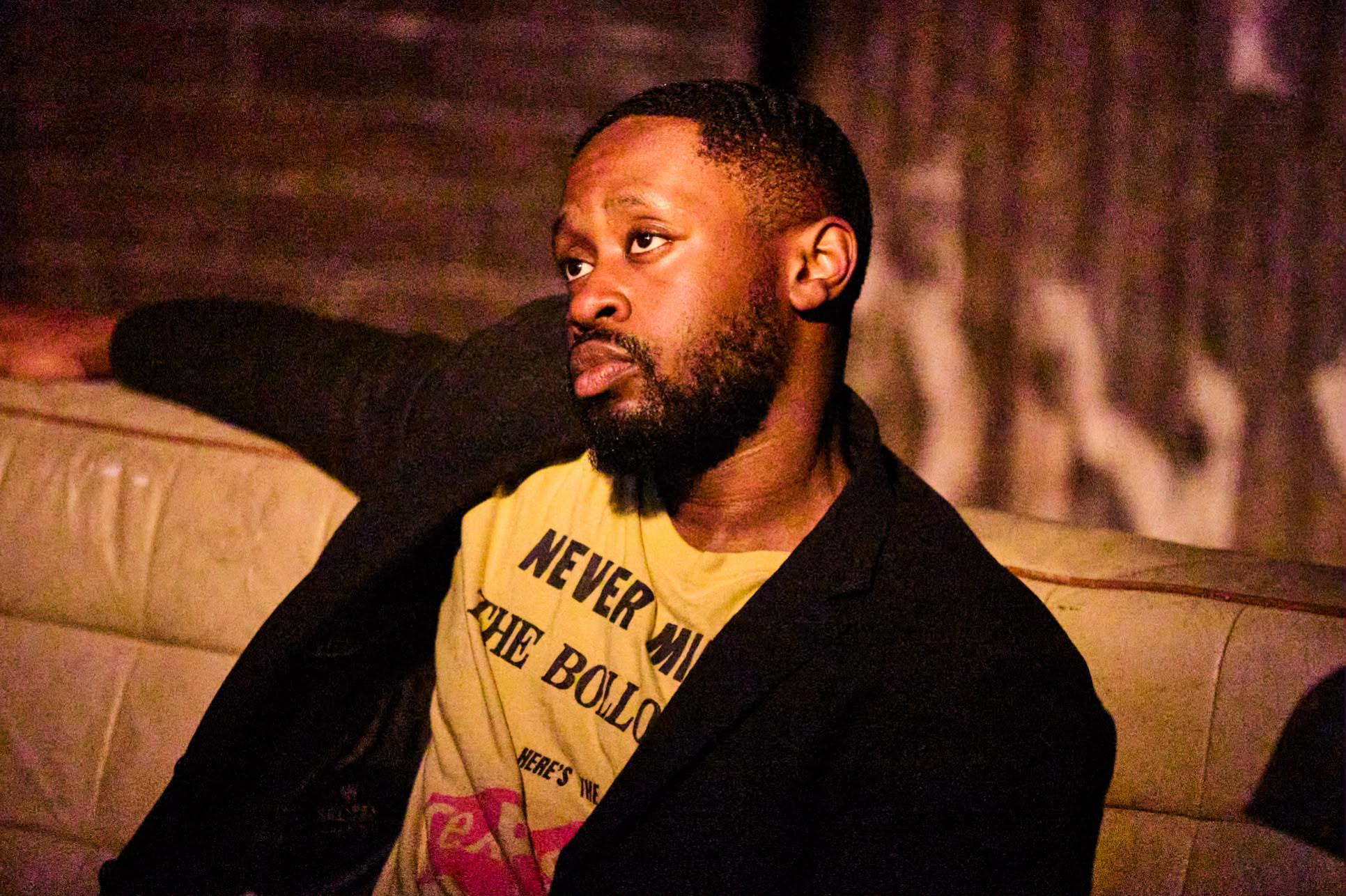
Eman Dare gives Danny an appealing confidence that gradually exposes the uncertainty beneath his ambitions. Still hoping that his band will achieve recognition, Danny appears to enjoy a freedom that Ted envies. Yet his life is equally repetitive, characterised by casual work, parties and the persistent belief that success is just around the corner. Dare captures the character’s easygoing charm and enthusiasm, making his optimistic declarations entertaining while allowing their increasingly familiar nature to reveal something more troubling.
Danny’s relationship with Charlotte provides much of his emotional conflict. He is determined to convince her that he has changed and is ready for a more serious commitment, but his promises are considerably more developed than his willingness to act upon them. Dare gives these declarations a persuasive sincerity, suggesting that Danny genuinely believes what he says, at least while he is saying it. His difficulty is not necessarily dishonesty, but an inability to recognise how often he has made the same promises before. As his confidence begins to falter, the character’s underlying vulnerability becomes more apparent.
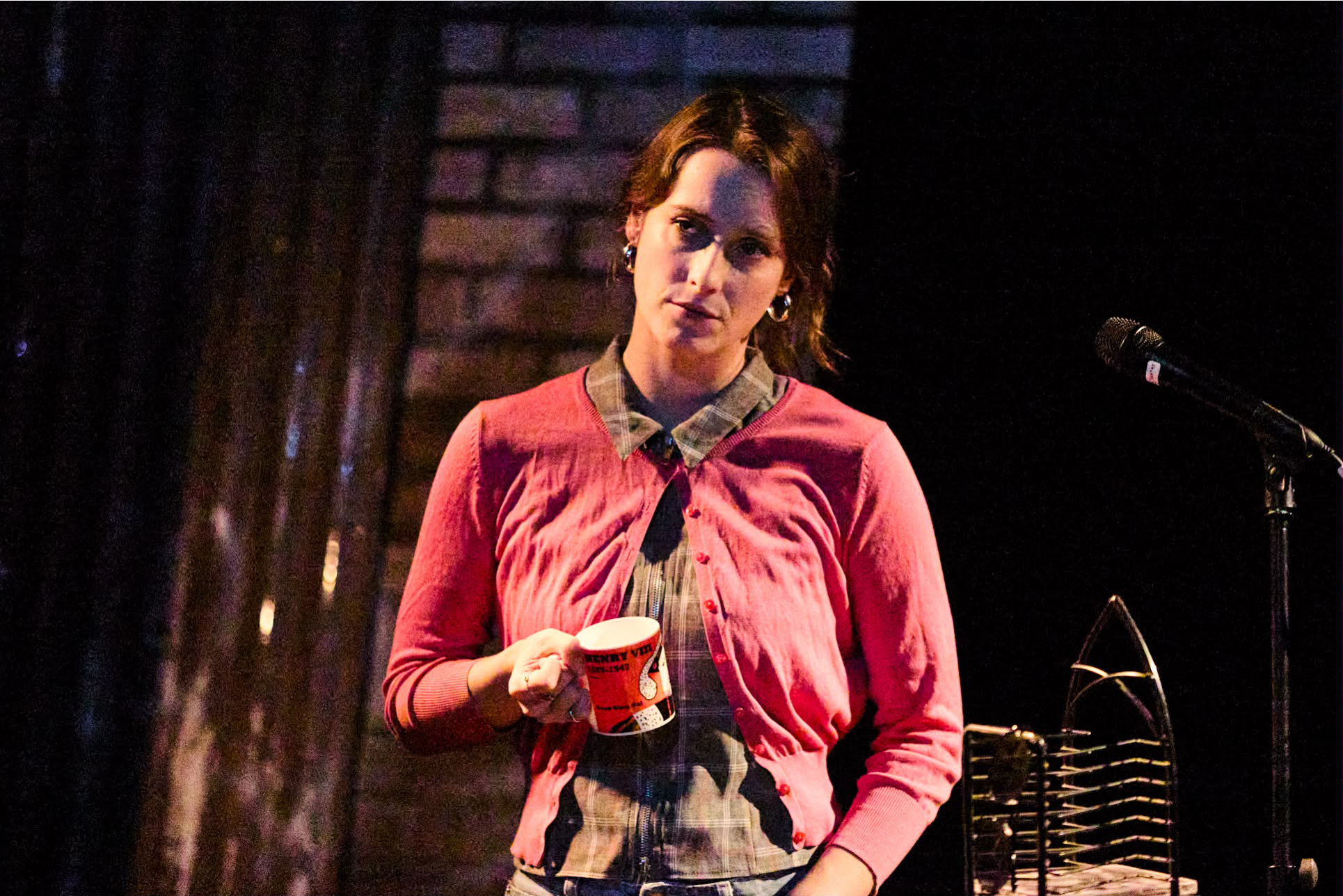
Caitlin Florence-Rose brings warmth, intelligence and emotional clarity to Charlotte, whose dissatisfaction extends beyond her personal relationships. As a teacher, she entered her profession hoping to make a difference, but now finds herself disillusioned by an education system in which opportunities are far from equally distributed. Her account of the contrast between her own pupils and the more privileged children she encounters elsewhere is particularly affecting. Florence-Rose gives this frustration a sense of genuine concern, making it clear that Charlotte’s exhaustion comes not from indifference, but from caring about something she increasingly feels powerless to change.
Charlotte is also perhaps the most determined of the friends to break away from her familiar circumstances. Her feelings towards Danny are complicated by affection, disappointment and a growing recognition that she cannot continue waiting for him to become the person he promises to be. Florence-Rose handles this conflict with sensitivity, balancing the character’s emotional attachment with her desire for independence. Charlotte’s insistence on honesty, rather than comforting declarations that may never be fulfilled, provides an important challenge to the evasions that characterise much of the friends’ conversation.
The relationships between the three characters are central to the play’s success. Tempest captures the particular familiarity of longstanding friendships, where affection can be expressed through insults, shared jokes and conversations that would make little sense to outsiders. These friends know one another intimately, yet often struggle to communicate their deeper feelings. They recognise one another’s weaknesses while remaining remarkably resistant to acknowledging their own.
There is considerable humour in these exchanges. An increasingly ridiculous discussion about establishing a mobile alcohol delivery business provides one of the lighter moments, as the friends enthusiastically invent names for an enterprise they are unlikely ever to pursue. Later, a conversation in a café finds Ted preoccupied with the practicalities of ordering breakfast while Danny wrestles with considerably more serious questions about his future. Such moments reveal Tempest’s understanding of how easily everyday distractions can interrupt even the most important conversations.
Rodrigues’ direction places the relationships at the centre of the production, making effective use of the Etcetera Theatre’s intimate performance space. The staging moves between individual reflections, encounters between the friends and passages in which all three performers step outside their characters to address the audience as a Chorus. The transitions between these different forms are particularly important, allowing the play to move from recognisable conversations into the wider anxieties that Tempest’s poetry explores.
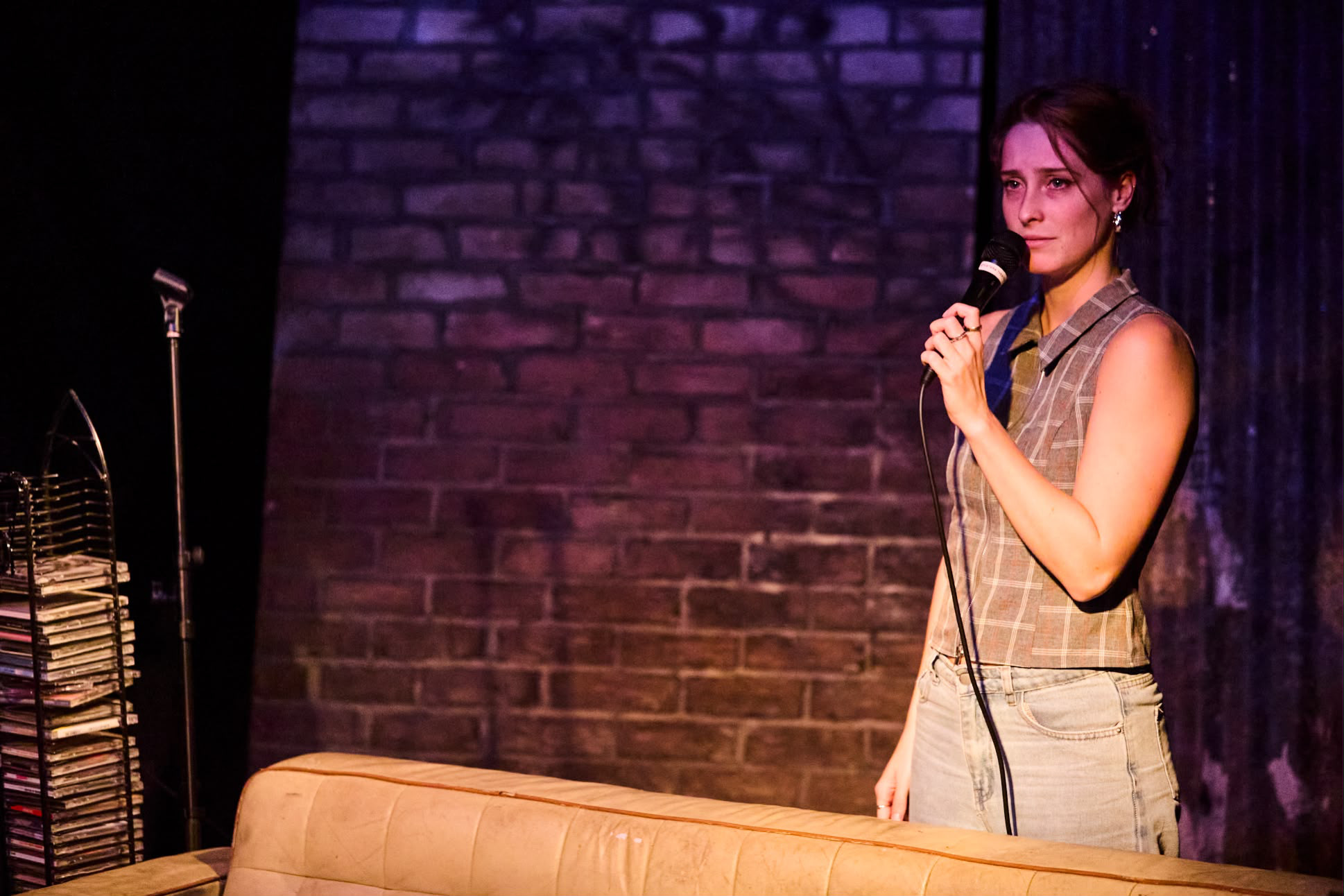
The Chorus gives the three actors opportunities to work collectively, sharing lines and building phrases through rhythm, repetition and changes of emphasis. Here the characters become representatives of something broader, speaking for a generation struggling with disappointment, uncertainty and the pressures of modern life. The use of microphones helps distinguish these passages from the more intimate conversations, giving the language a stronger sense of direct address.
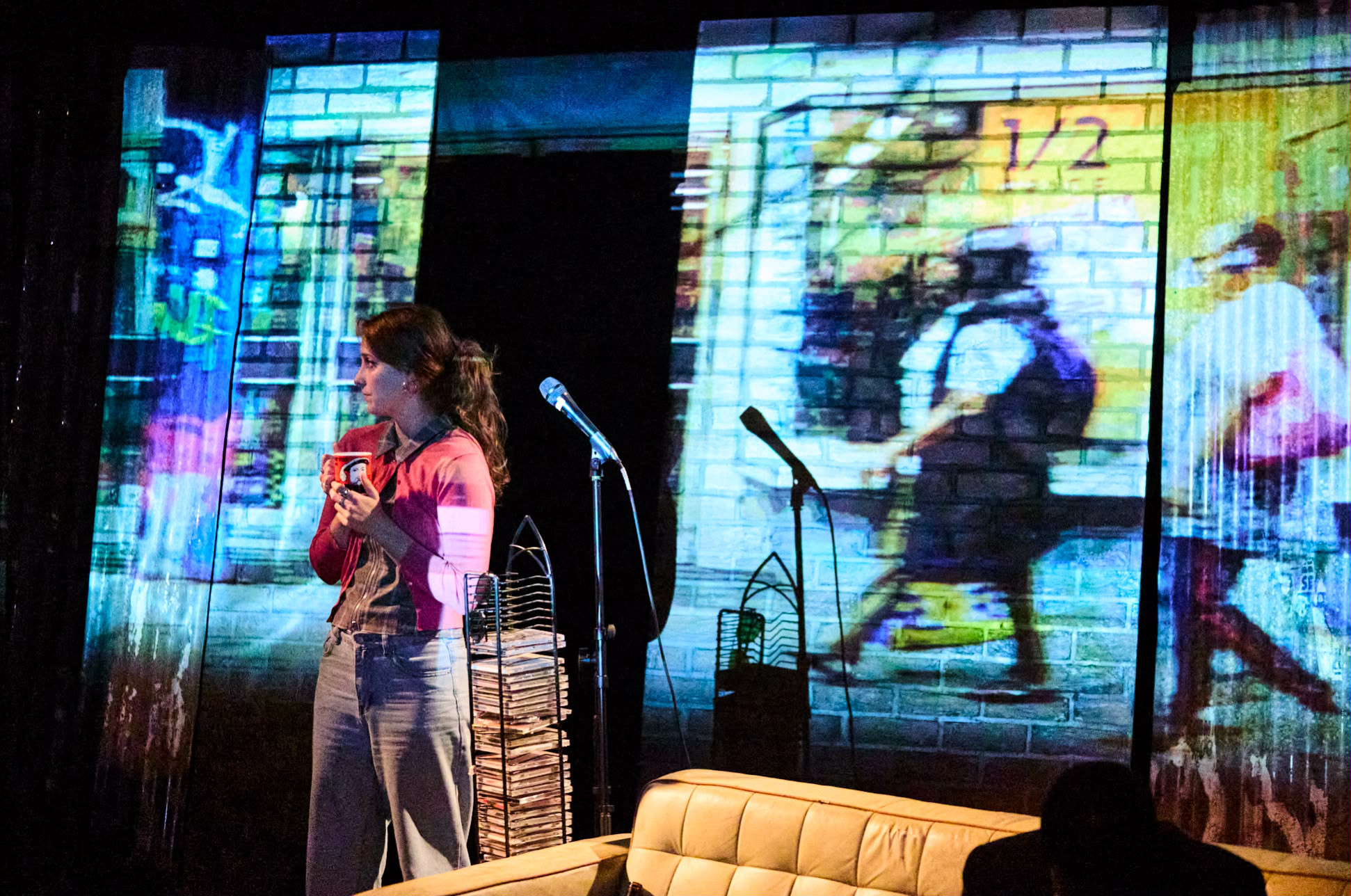
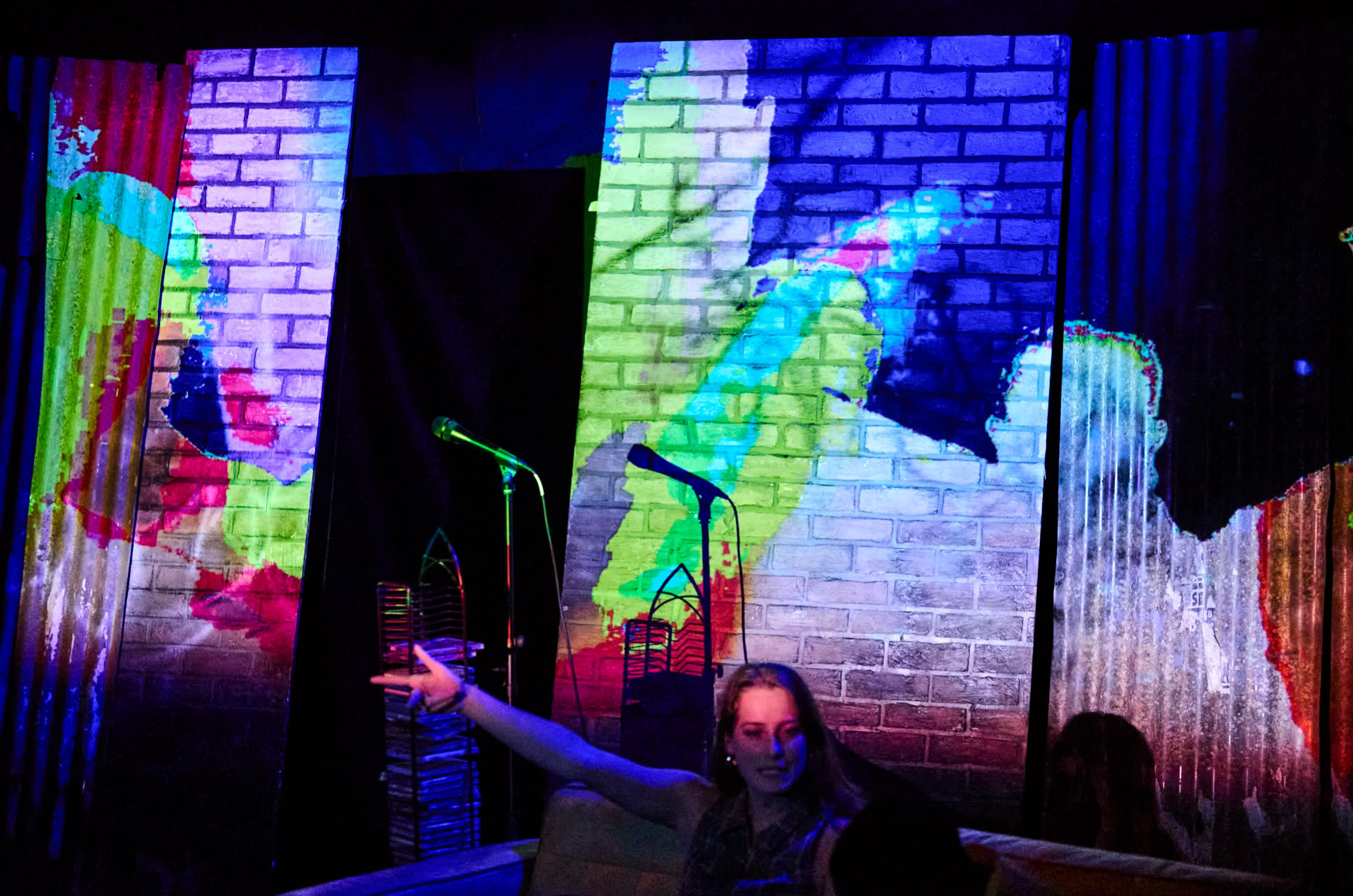
Anna Cecilia’s set design makes economical use of the available space, with a worn sofa, simple furniture and a brickwork backdrop establishing a recognisable urban environment. The setting feels suitably informal, providing a place where the friends can gather, talk and retreat into the familiarity of one another’s company. It also allows locations to change without elaborate alterations to the stage.
Projection design by Leila Ufer, working with Rodrigues and Farrell, introduces images of London that extend the world beyond the theatre. Combined with Mimi Browne’s lighting, the projections create striking changes in atmosphere, with vivid blues, greens and reds contrasting against warmer, more subdued tones. These visual elements are particularly appropriate to a play in which everyday routine and the temporary exhilaration of nightlife exist alongside one another.
The sound design, credited to Ryan Nicholas and Oscar Mangini, has an important role in establishing the surrounding city and the changing atmosphere. Tempest’s writing is rooted in London’s streets, workplaces, pubs and nightlife, and the movement between urban soundscapes, music and spoken dialogue helps connect the characters’ private frustrations to the wider environment in which they live.
The play also raises questions extending beyond the familiar difficulties of growing older. Charlotte’s experiences as a teacher introduce issues of class and opportunity, while the friends’ relationships with work expose the different ways employment can restrict or define people’s lives. Ted resents the security he has achieved, Danny avoids responsibilities in pursuit of an uncertain ambition, and Charlotte struggles with the gap between her ideals and the practical realities of her profession.
Alcohol and drugs provide another recurring theme. The friends associate intoxication with freedom, companionship and the excitement of their younger years. As their inhibitions disappear, they become more affectionate and increasingly confident that their futures can be transformed. Yet these moments of temporary liberation are followed by the familiar return of responsibilities, uncertainty and regret.
Tempest is particularly perceptive about the difference between recognising the need for change and having the determination to make it happen. The characters are not lacking in self-awareness. They can identify their frustrations, recognise opportunities and describe the lives they would prefer to lead. What they struggle with is the difficult business of doing something about it.
Although Tempest’s naturalistic dialogue is frequently engaging, the narrative itself could benefit from greater development. Much of the play involves the characters revisiting familiar frustrations, making ambitious declarations and subsequently returning to their old habits. While this repetition is central to the play’s message, it sometimes limits the dramatic progression. Charlotte’s storyline is particularly frustrating, as her apparent determination to change ultimately leads her back towards the circumstances she had hoped to escape. Her decision to remain and recommit herself to teaching offers some hope, but the play leaves considerable doubt about whether her intentions will translate into action. This is undoubtedly part of Tempest’s intention, although the narrative might have benefited from allowing the characters to confront their circumstances through more substantial dramatic developments.
The Chorus passages, although often powerful, can also become repetitive, sometimes reinforcing ideas already expressed more effectively through the characters’ conversations. There are occasions when social commentary takes precedence over drama, with the writing explaining its themes rather than allowing them to emerge naturally through the action. These are areas that could be addressed in future productions, particularly through tighter pacing, more varied treatment of the Chorus and greater emphasis on the dramatic exchanges. A more substantial narrative would require changes to the original text, but a stronger balance between poetry, character development and dramatic action could elevate an already engaging production further.
The title gathers several meanings as the story progresses. Being wasted describes the intoxication that accompanies the friends’ attempts to escape their troubles, but it also refers to time, opportunities and potential slipping away. The play’s final moments bring these ideas together with an uncomfortable recognition of how easily sincere intentions can become another familiar routine.
What makes Wasted affecting is its refusal to dismiss its characters simply because they repeatedly disappoint themselves. Ted, Danny and Charlotte are capable of selfishness, avoidance and poor judgement, but their affection for one another remains genuine. Their mistakes are recognisable, and their hopes, however unrealistic, are difficult not to sympathise with.
Wasted is an engaging, frequently funny and often poignant examination of friendship, lost opportunities and the uneasy transition into adulthood. Workhouse Productions brings together three appealing performances in a production that makes effective use of its intimate setting. While a more developed narrative and greater restraint in some of the Chorus passages could lift the material further, there is much to appreciate in Tempest’s perceptive writing and the relationships between its characters. Its central question remains relevant well beyond their age or circumstances: how much of our lives do we spend imagining a different future, while allowing the present to pass us by?
Meet the Performers
Freddie Farrell
TED | ACTOR & PRODUCER
Freddie Farrell is a London-based actor and producer who graduated from Rose Bruford College in 2023, having studied American Theatre Arts. His stage credits include There's a City in My Mind, Moscow, Moscow, Moscow, Moscow, Moscow, Moscow, Somewhere in England and Let the Right One In. He has also worked in voiceover, including Out of Bounds. Alongside his acting career, Freddie has an interest in photography and writing. In 2026, he played Ted in Kae Tempest's Wasted at Etcetera Theatre, which he also produced through Workhouse Productions.

Caitlin Florence-Rose
CHARLOTTE
Caitlin Florence-Rose is a stage and screen actor whose credits include Sex Education, the short films Sunday Roast and Eventide, and the independent drama Notion. She has also worked as Millie Bobby Brown's stand-in and double on Enola Holmes 3. Her theatre appearances include Mr. Stevens at Arches Lane Theatre, in which she played Rose, and Kae Tempest's Wasted at Etcetera Theatre. Caitlin studied at Arts University Bournemouth and has experience in physical theatre. Her work spans independent film, television and live performance.

Eman Dare
DANNY
Eman Dare is a London-based actor who trained at the Identity School of Acting (IDSA). His stage work includes the original production A Summer at the Averno at the Union Theatre, where he played Reginald, a sharp-witted handyman. Directed by Emily Rodrigues, the production preceded their collaboration on Kae Tempest's Wasted at Etcetera Theatre, Camden. In Wasted, Dare portrays Danny, an aspiring musician whose ambitions, relationships and repeated promises to change are central to the play's examination of friendship, regret and unfulfilled potential.
Cast & Creatives
- Showing: Saturday 19th and Sunday 20th September 2026 at 7.30pm
- Venue: Etcetera Theatre, 265 Camden High Street, Camden, London NW1 7BU
- Buy Tickets: https://www.etceteratheatrecamden.com/
- Running Time: Approximately 1 hour 15 minutes
- Production: Workhouse Productions
- Written By: Kae Tempest
- Director: Emily Rodrigues
- Producer: Freddie Farrell of Workhouse Productions
- Set Designer: Anna Cecilia
- Set Assistants: Lara Wilson and Lara Daly
- Lighting Designer: Mimi Browne
- Sound Designers: Ryan Nicholas and Oscar Mangini
- Projection Design: Leila Ufer, with Emily Rodrigues and Freddie Farrell
- Costume Sourcing & Design: Lara Wilson
- Production Photography: Paul Farrell
- Cast:
Freddie Farrell as Ted
Eman Dare as Danny
Caitlin Florence-Rose as Charlotte
An engaging and poignant portrait of friendship, regret and unfulfilled ambitions
Summary
Workhouse Productions brings Kae Tempest’s Wasted to life with three engaging performances, combining humour, friendship and the frustrations of growing older. The naturalistic dialogue and emotional depth are particularly effective, although a more developed narrative and less repetitive Chorus passages could have elevated the production further.


Add comment