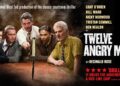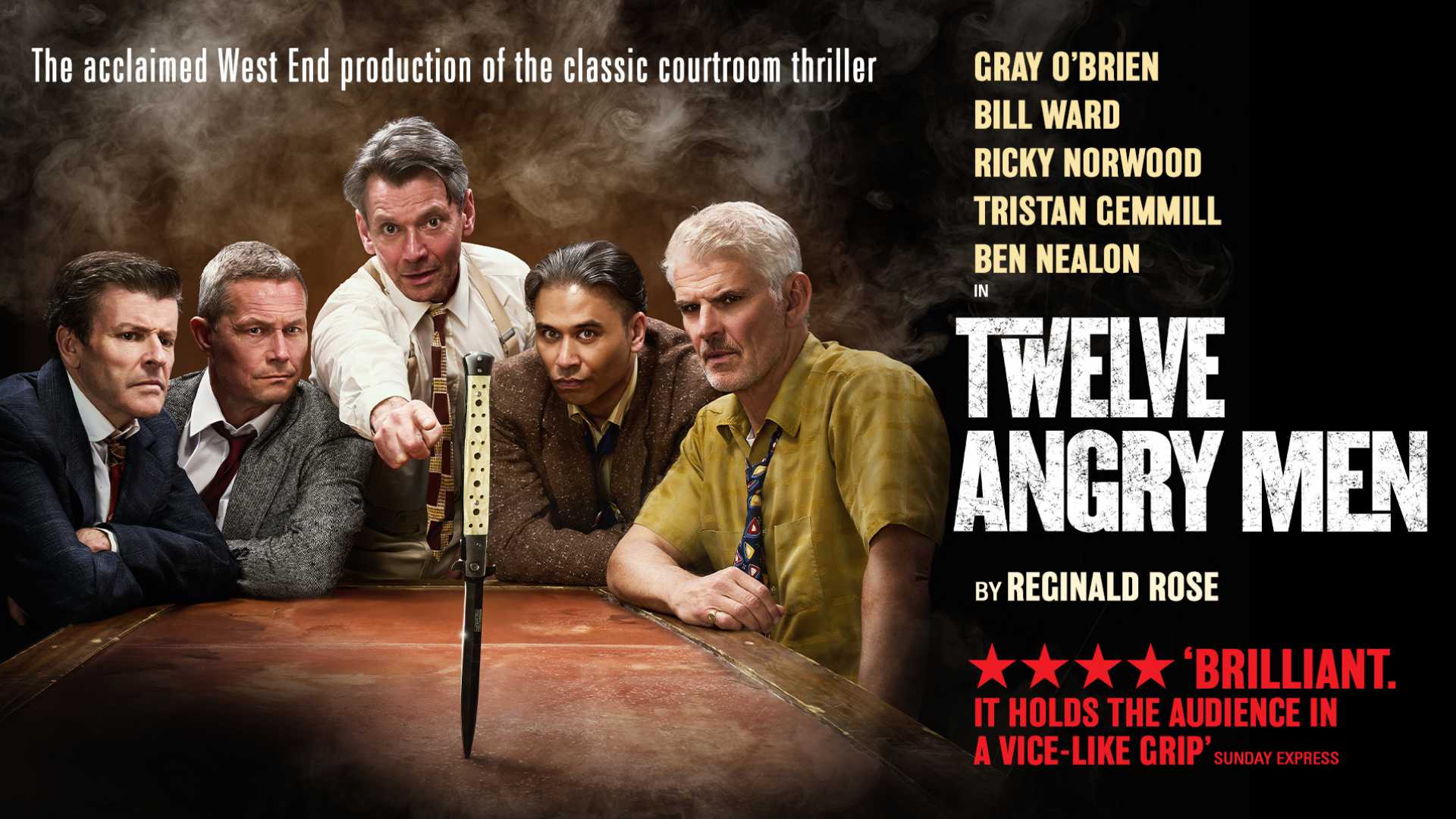
Christopher Haydon’s production of Twelve Angry Men opens with certainty already beginning to crack. Twelve jurors enter a hot New York jury room expecting a swift decision; what follows is anything but.
Bill Kenwright Ltd’s acclaimed production arrives at Theatre Royal Windsor at the beginning of a new UK tour, with Christopher Haydon directing an experienced company that includes several faces familiar from British television.
At the centre of proceedings is Gray O’Brien as Juror 8, the sole member of the jury initially unwilling to return a guilty verdict. O’Brien gives the character a calm, measured authority that remains remarkably consistent even as tempers rise around him. He thoughtfully explains his concerns rather than seeking to dominate the room, and there is something entirely believable in the way he is able both to de-escalate confrontation and patiently draw the others back towards the weaknesses he sees in the case. Rather than presenting Juror 8 as a crusading hero, O’Brien makes him thoughtful, humane and quietly persistent. His restraint becomes one of the production’s great strengths, particularly when set against the increasingly combustible personalities around him.
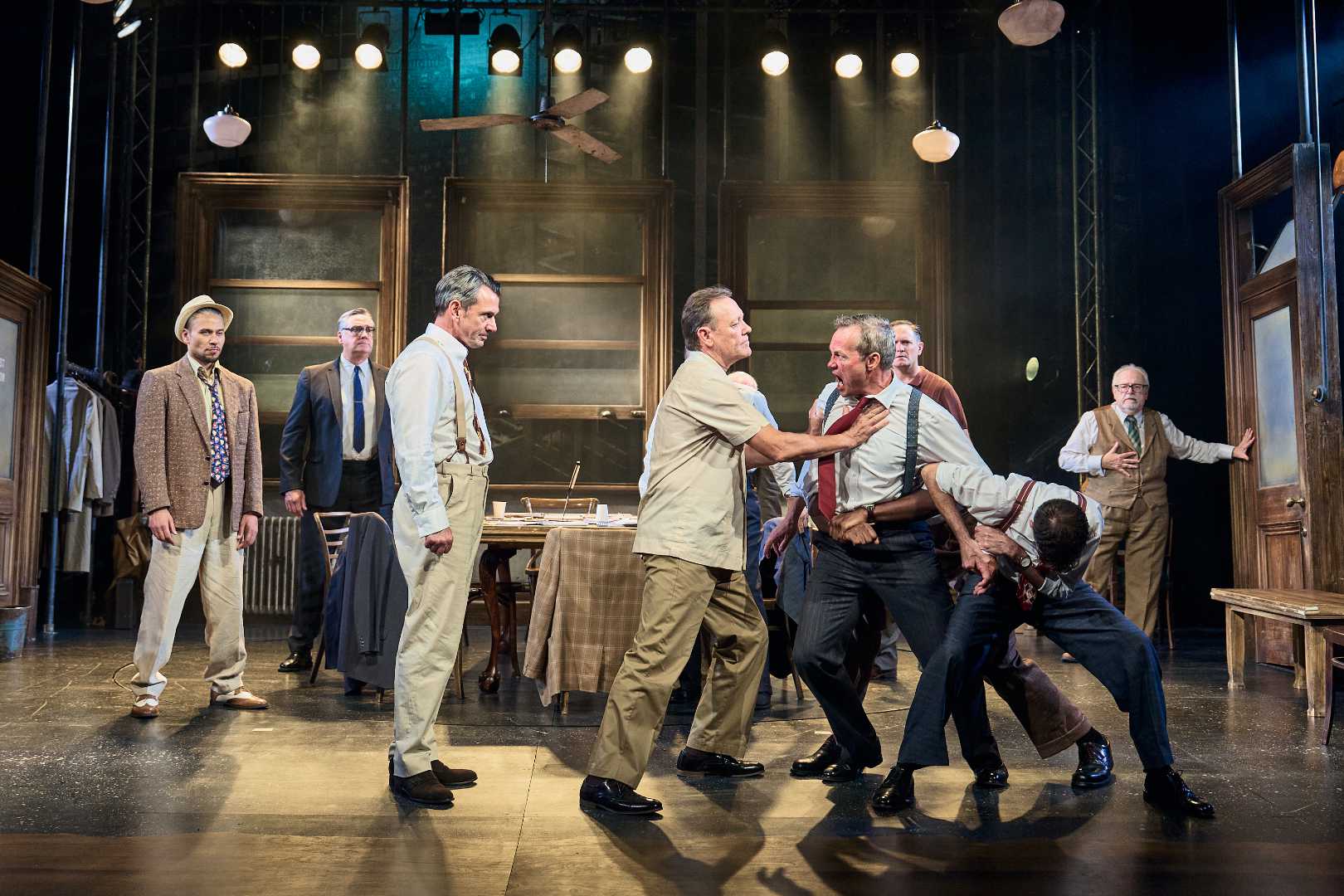
Bill Ward gives one of the evening’s strongest performances as Juror 3. From the outset he brings considerable force and intensity to a man utterly convinced of the defendant’s guilt, but Ward gradually reveals that there is something much more personal driving that certainty. His anger can be explosive, yet flashes of vulnerability begin to appear beneath it as the evening progresses.
The later speech in which Juror 3 speaks as though he can almost feel the knife going into him is especially powerful, exposing how completely his own damaged relationship with his son has become entangled with the case. When the character finally breaks down, Ward allows the bluster and aggression to fall away, leaving us with a broken man forced to confront the hurt and inner demons he has spent much of the play projecting elsewhere. It gives the ending a poignancy that reaches well beyond the verdict itself.
The conflict between O’Brien and Ward consequently provides much of the production’s dramatic electricity. One pushes quietly at apparent inconsistencies while the other increasingly fights to preserve the certainty with which he entered the room. Their contrasting performances give the evening a strong central axis.
Ricky Norwood, well known as Fatboy in EastEnders, brings considerable energy to Juror 7 and provides welcome comic relief within the increasingly serious atmosphere of the jury room. His accent is convincing and he physically owns the role, giving the character a restless confidence and impatience that make him immediately distinctive among the twelve.
Norwood handles the humour particularly well, earning genuine laughs without allowing the character to become merely comic. Beneath the wisecracks and eagerness to escape for his baseball game lies something rather less comfortable: the casual selfishness of a man whose chief concern is getting out of the room rather than properly considering the fate of the accused.
Tristan Gemmill, familiar to television audiences as Dr Adam Trueman in Casualty and recently seen at Theatre Royal Windsor in The Marquise, gives Juror 10 a deeply disturbing and increasingly repellent presence. Gemmill commits fully to the character’s prejudice, allowing his major speech to expose the full extent of the hatred he has been carrying into the jury room.
It is uncomfortable to watch, as it should be, yet Gemmill also finds something almost pitiable beneath the ugliness. As Juror 10 lays bare his prejudices and the other men become increasingly unwilling to engage with him, the character seems to diminish through his own isolation. The audience is made to thoroughly dislike him, and that is in no small part a testament to how effectively Gemmill inhabits such an unpleasant role.
Mark Heenehan gives Juror 4 a suitably stiff and controlled presence. The character is a broker, and Heenehan makes that professional background immediately believable through the precision of his diction, his rigid posture and the sense that every argument is being carefully weighed before being expressed. While several of the other jurors become increasingly emotional, Juror 4 remains cool and analytical, relying upon what he regards as the hard facts of the case. Heenehan’s restraint consequently gives the character a quiet authority.
Ben Nealon, remembered as Captain Jeremy Forsythe in Soldier Soldier, brings a polished, slightly fickle quality to Juror 12, whose professional confidence is accompanied by rather less certainty when required to make a decision of genuine consequence. His changes of mind provide another reminder of just how differently the twelve men approach their responsibility.
The strength of the production extends throughout the company. Paul Beech brings a quietly observant quality to Juror 9, while Kenneth Jay gives Juror 11 a thoughtful dignity and measured intelligence. Micquel Pereira, making his professional stage debut as Juror 5, makes a confident contribution when the character’s own experience becomes important to the discussion, and Tim Maxwell-Clarke finds the hesitant quality of Juror 2 without allowing him to disappear among the stronger personalities around the table.
Jeffrey Harmer gives Juror 6 a grounded decency, while Owen Oldroyd provides an appropriately steadying presence as the increasingly tested Foreman. Graham Elwell, in the smaller role of the Guard, neatly frames those moments when the outside world briefly intrudes upon the jury room.
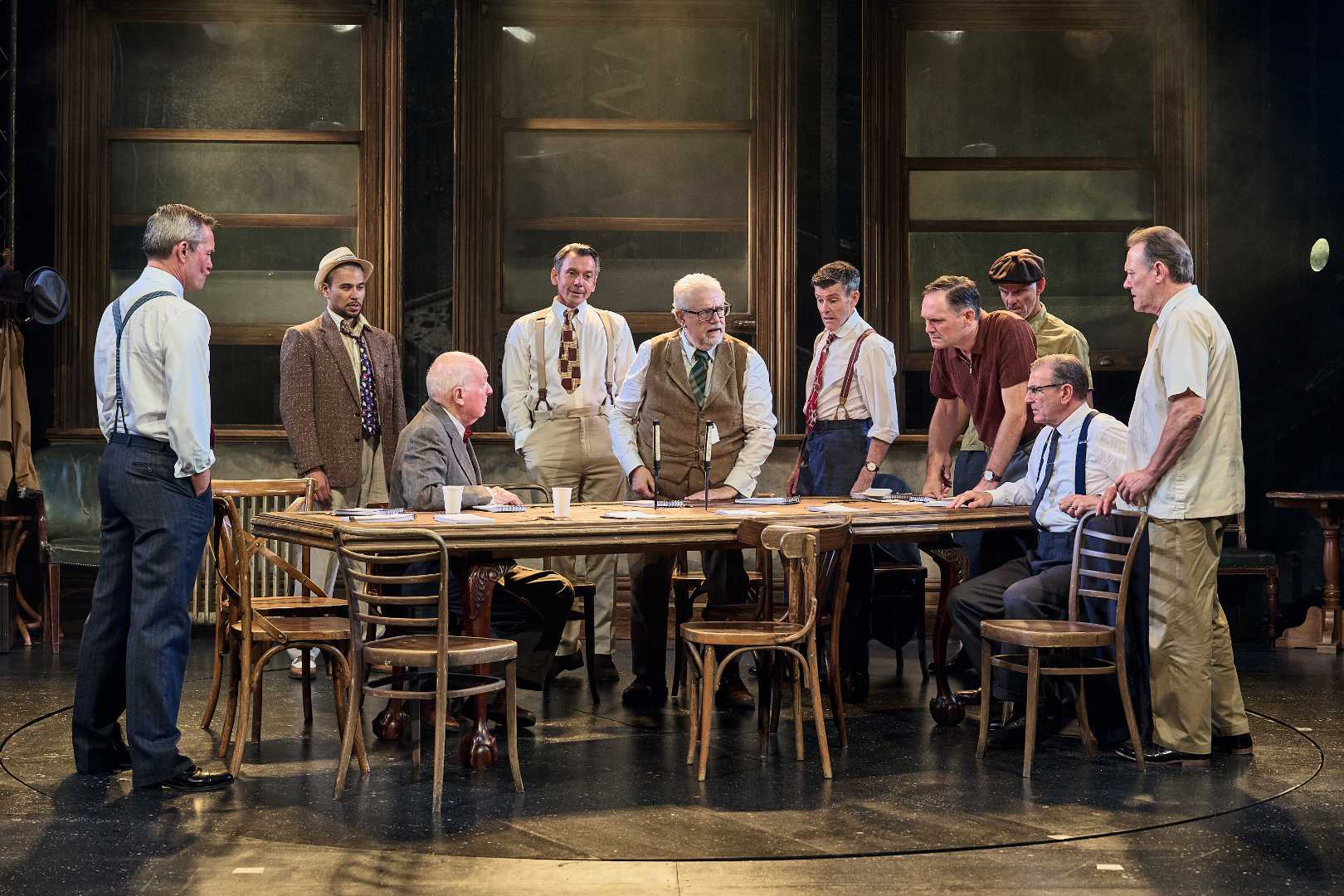
Haydon keeps the production moving despite the deliberate confinement of its setting. With twelve performers occupying essentially the same room for almost the entire evening, the danger is that proceedings could become visually static. Instead, shifting positions around the table and movement into the surrounding areas of the room mirror the gradual movement of opinion within the jury. Characters withdraw, confront one another, form temporary alliances and find themselves increasingly isolated as the balance begins to change.
Michael Pavelka’s jury-room design proves particularly effective and rewards closer attention. The large central table and surrounding chairs sit within a circular revolve, framed by the wider jury room and three tall windows at the rear. Around them are the practical details of a tired civic building: radiators beneath the windows, washbasins, coat hooks, a water cooler and the various functional furnishings of a room designed for deliberation rather than comfort. Together they give the space a convincingly worn, institutional character.
The revolve turns at intervals to alter the audience’s perspective on those seated around the table, while much of the action also spills into the fixed areas surrounding it. Its movement is impressively unobtrusive. At times, dialogue elsewhere in the room and Chris Davey’s carefully directed lighting draw the audience’s attention away from the table while the revolve quietly changes position. On several occasions I barely noticed it moving at all, only becoming aware afterwards that our view of the jury had shifted. It is a subtle and intelligent piece of staging that keeps the confined setting visually alive without distracting from the performances.
The oppressive heat hanging over the room adds another layer of tension. Jackets come off, patience shortens and the physical discomfort seems to seep into the deliberations themselves. Even the fan above the table initially refuses to work, adding to the sense that there is little escape from the heat, before eventually coming to life later in the proceedings.
When the weather finally breaks, the change is beautifully realised. Rain can be seen falling outside the three large windows at the rear of the set, creating a particularly convincing atmospheric effect. It transforms something that could easily have existed only in dialogue and sound into a tangible part of the world beyond the jury room.
What is particularly effective is the way the production allows apparently small observations to accumulate. Evidence which initially seemed definitive begins to look rather less secure once somebody pauses long enough to question it. The tension comes not from uncovering some spectacular hidden clue, but from watching certainty slowly eroded by doubt.
Haydon allows sufficient humour into proceedings to prevent the evening becoming relentlessly solemn. The personalities around the table are sharply differentiated, and their irritations, jokes and petty disagreements make them recognisably human. That in turn makes the more serious confrontations considerably more potent.
The production retains its period setting and some aspects unmistakably belong to 1950s America, yet the questions raised inside this jury room have lost remarkably little of their relevance. The ease with which certainty can become entrenched, and judgement coloured by what people bring into the room with them, remains strikingly familiar. It does briefly invite the thought of what a more contemporary jury might bring to the play, but this production makes a persuasive case for allowing Rose’s original setting to speak for itself.
Most importantly, Twelve Angry Men never feels like twelve interchangeable figures conducting an abstract debate. The strength of this production lies in the distinct personalities gathered around the table and in the gradual revelation of what each man brings with him into that room.
O’Brien’s quietly persuasive Juror 8 and Ward’s increasingly combustible Juror 3 provide the production with an absorbing central confrontation, while Norwood, Gemmill and Heenehan each create sharply defined characters within a strong ensemble.
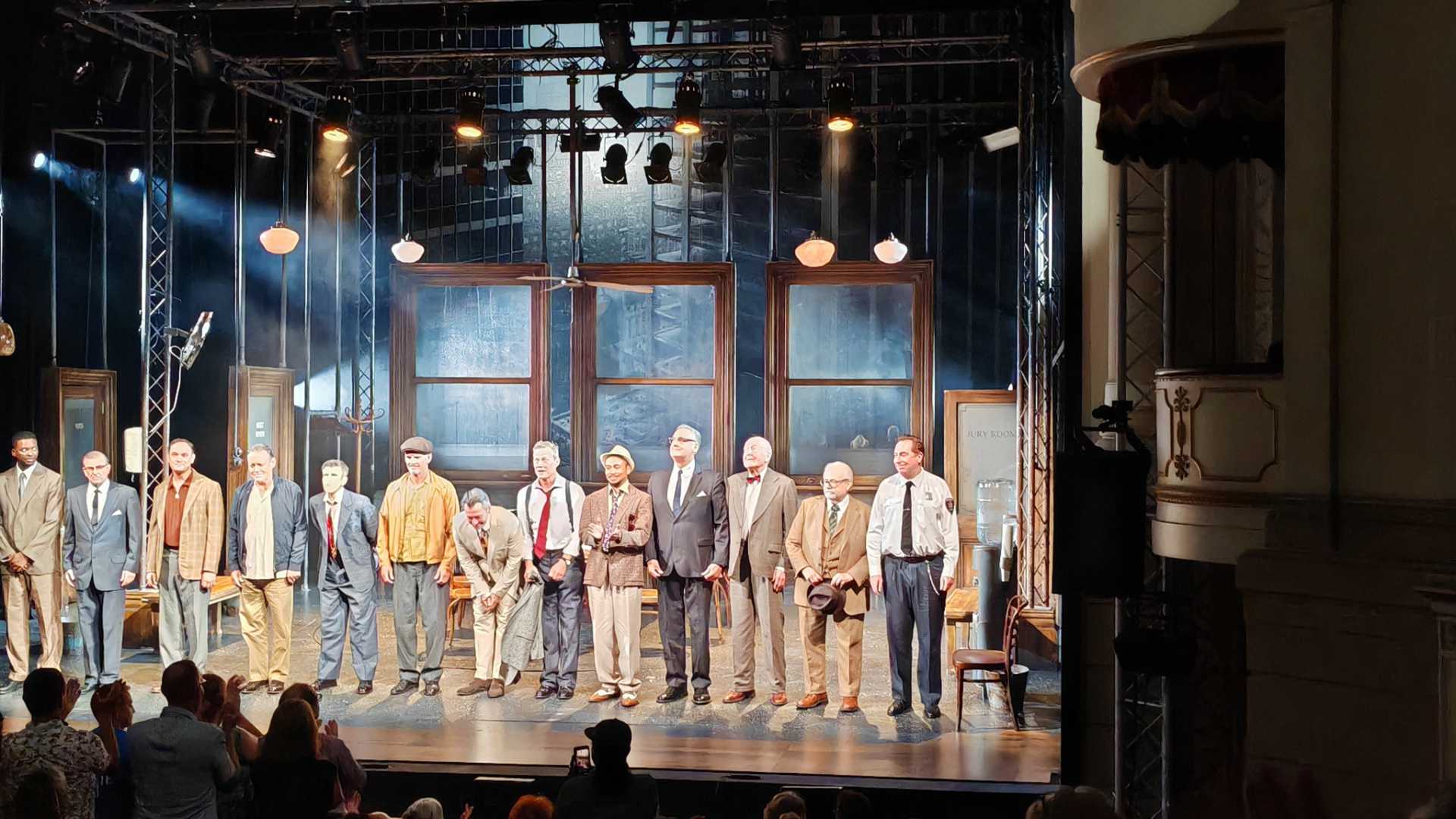
The final moments prove particularly poignant, not least through Ward’s collapse as Juror 3 is finally forced to confront what has really been driving him. The audience response reflected the strength of the performance, with a deserved partial standing ovation greeting the company at the curtain call.
What begins as an apparently straightforward vote becomes a taut examination of certainty, prejudice and responsibility. Haydon’s production steadily tightens its grip as the balance around the table begins to shift, demonstrating just how gripping twelve men, one room and a reasonable doubt can be.
Cast & Creatives
- Showing: 3rd – 12th September 2026
- Running Time: 2 hours 20 minutes, including a 20-minute interval
- Venue: Theatre Royal Windsor, 32 Thames Street, Windsor, Berkshire SL4 1PS
- Buy Tickets: https://theatreroyalwindsor.co.uk/twelve-26/
- Writer: Reginald Rose
- Director: Christopher Haydon
- Associate Director: Tim Welton
- Stage Designer: Michael Pavelka
- Lighting Designer: Chris Davey
- Sound Designer: Andy Graham
- Presented by: Bill Kenwright Ltd
- Production Photography: Manuel Harlan
- Cast:
Bill Ward as Juror 3 (Coronation Street, Emmerdale)
Ricky Norwood as Juror 7 (EastEnders)
Tristan Gemmill as Juror 10 (Casualty)
Ben Nealon as Juror 12 (Soldier Soldier)
Paul Beech as Juror 9
Graham Elwell as Guard
Jeffrey Harmer as Juror 6
Mark Heenehan as Juror 4 (Avenue 5)
Kenneth Jay as Juror 11
Tim Maxwell-Clarke as Juror 2
Owen Oldroyd as Foreman
Micquel Pereira as Juror 5
Twelve men, one verdict, and a gripping battle over reasonable doubt
Summary
Christopher Haydon’s taut production builds steadily from uneasy deliberation into a charged clash of personalities, with Gray O’Brien and Bill Ward anchoring a strong ensemble in Reginald Rose’s enduring courtroom drama.


Add comment