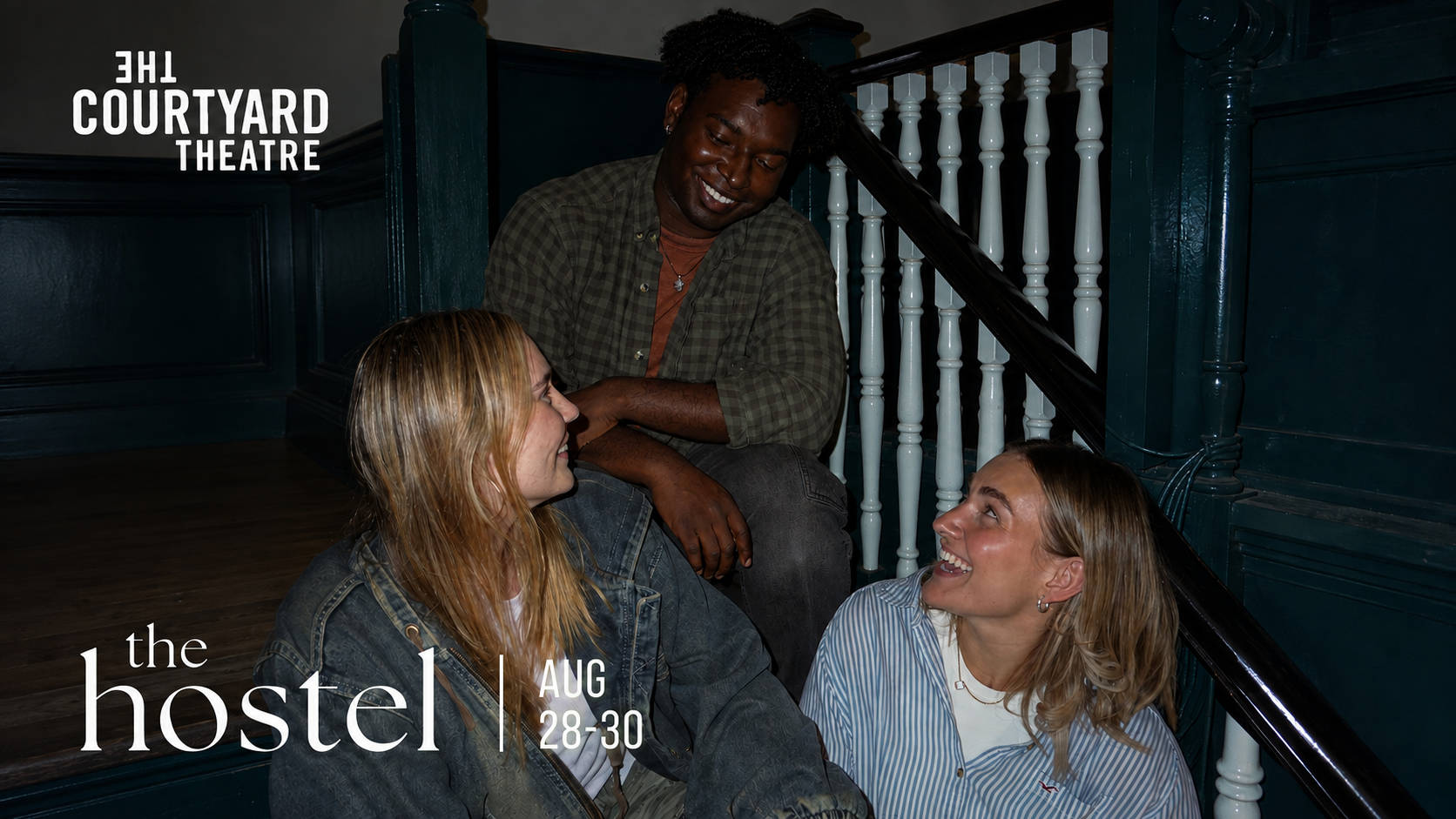
A group holiday can expose fault lines in even the closest friendships. In The Hostel, presented at The Courtyard Theatre as part of Camden Fringe, three young friends arrive in New York with very different expectations, only for their carefully anticipated trip to unravel around them. Written and directed by Isabella “Iz” Haldren, the play begins as a lively situational comedy before developing into a darker ensemble drama about friendship, control, consent and the communities that strangers can create.
Ivy, Jake and Bea arrive with their luggage and a formidable collection of rules compiled by Ivy, the only member of the group with previous experience of the city. When the hostel separates them between two dormitories, friendships, attractions and suspicions quickly form, while a disagreement over how to spend the holiday sends the three companions in different directions.
The dialogue has an unapologetically youthful rhythm, filled with slang, overlapping remarks, affectionate mockery and the social awkwardness of people still learning how to navigate adult relationships. This makes the production particularly accessible to younger adults. Although the friendships and emerging dynamics are readily understood, the names of the three principal characters could be established more firmly before the larger hostel group is introduced.
Aimee Sturgess makes Ivy immediately recognisable as an excessively organised planner, worried about every potential problem New York might present. Crucially, Sturgess keeps her likeable, grounding the character’s overbearing behaviour in genuine concern for her friends. As Ivy’s carefully devised plans disintegrate, Sturgess reveals the uncertainty and vulnerability beneath her apparent confidence.
Although Ivy cautions Jake about his temper early on, KJ Adams presents him primarily as impulsive and protective. His strongest argument with Ivy resembles a recognisable disagreement between young friends on holiday rather than evidence of an unusually volatile disposition. Adams is more persuasive when conveying Jake’s instinct to defend somebody in danger and the physical and emotional vulnerability that follows.
Lily Forbes gives Bea an engaging combination of innocence, confidence and comic exuberance. Her naïvety becomes increasingly apparent through her willingness to approach strangers and trust people she does not know, even while lost and alone. Forbes plays Bea’s later intoxication with committed physical comedy, while retaining enough vulnerability to ensure that the audience continues to feel for her rather than merely laughing at her predicament.
The other dormitory initially contains what appears to be the settled relationship between Holly and George. That apparent stability rapidly disappears when Antonia installs herself like a cuckoo in the nest, monopolising George’s attention while largely pretending that Holly is not there. The audience’s laughter at these interactions is noticeably nervous, arising from the brazenness and discomfort of the situation rather than uncomplicated comedy.
Briana Croitoru stands out by making Antonia thoroughly conniving and dislikeable, exactly as the character requires. Her exaggerated friendliness barely conceals her intentions, while her refusal to recognise reasonable boundaries makes every interaction increasingly awkward. The strength of the audience’s antipathy demonstrates how effectively Croitoru tackles the role.
Jessica Eden gives Holly a quiet dignity, ensuring that her discomfort is felt even while the character tries to remain diplomatic. Eden’s restraint gathers emotional weight as Holly’s isolation and accumulated hurt become harder to conceal. Daniel Vickers, meanwhile, allows George’s unpleasantness to emerge progressively. What begins as self-centred and possessive behaviour develops into intimidation and an increasingly disturbing abuse of power.
A shocking hospital encounter between George and Jake is deliberately uncomfortable. Vickers and Adams communicate both George’s violation of boundaries and Jake’s medicated confusion with clarity. The scene is effectively handled, although it represents the play’s most abrupt narrative turn. The earlier action appears to be moving towards a resolution of the George, Holly and Antonia triangle, making this darker development unexpected and raising the question of whether it has been sufficiently prepared. Nevertheless, it introduces serious questions about consent, coercion and an aggressor’s attempts to minimise what has occurred.
Among the supporting characters, Oscar Honeysett gives the reserved Andy an understated decency, particularly when he assumes responsibility for getting the intoxicated Bea to hospital. Andy nevertheless remains primarily a functional observer, used as a safe friend to Holly and an innocent focus for George’s jealousy. The character would benefit from a more fully developed individual arc.
Georgy Smales brings lively eccentricity to Shandy, supplying welcome comedy while also uncovering an unexpectedly perceptive and supportive side. Shandy’s unusual pronouncements and attempted cafeteria raid offer the audience valuable breathing room between the more distressing scenes. Although principally a supporting presence, Smales makes the character’s moments count.
Despite being repeatedly described by other characters as intimidating, Parker appears gentle in nature. Jake Moon brings warmth and dependability to the role, making his developing connection with Ivy appealing. The contrast between Parker’s supposedly threatening appearance and his actual personality is more often stated than demonstrated, but Moon establishes him convincingly as somebody upon whom the increasingly fractured group can rely.
Lola Núñez and Kiefer Bryson support the production through its ensemble roles, helping to populate the streets and hospital while maintaining the brisk transitions between locations.
The staging is understandably economical. Before the dialogue begins, the hostel worker lays blue-and-white bedding on opposing sides of the black-box space, efficiently establishing the two dormitories. The folding chairs, central box and other props are basic but functional within the production’s fringe setting. Lighting is similarly straightforward, although four red-and-blue lights flash effectively to evoke a passing police vehicle.
Bea’s drug-induced disorientation relies principally upon Forbes’s performance. In a larger production, more expansive sound, lighting or visual design could deepen the dreamlike experience, but Forbes successfully carries the sequence within the available technical resources.
The most technically accomplished passages are the physical confrontations. Fight director Jason Theodoulou, working with fight captain and movement director Annie Porter, gives the violence a visceral immediacy. Carefully placed freezes allow other strands of action to continue before the fights resume, keeping the simultaneous events clear and giving the sequence a cinematic rhythm. The controlled handling of the hospital encounter also reflects the contribution of intimacy coordinator Federica Lodato, allowing the moment to remain disturbing without becoming exploitative.
Some of the plot mechanics feel convenient. A group travelling together might more naturally have remained in one another’s company, while the repeated separations primarily serve to place individual characters in danger or allow new relationships to form. Several character attributes, including Jake’s temper and Parker’s intimidating presence, are also communicated through what others say rather than consistently demonstrated through behaviour. Andy and, to a lesser extent, Shandy would both benefit from further development.
Even so, Haldren keeps the numerous relationships and concurrent events understandable, while the quick pace prevents the lighter interludes from lingering once the story has taken its darker turn. The recurring comedy proves valuable, giving the audience opportunities to breathe without completely diminishing the seriousness of the later material.
At its best, The Hostel captures the conversational energy, questionable decisions and complicated loyalties of young adults testing both their independence and their friendships. Its humour makes the characters approachable before the production asks more troubling questions about intervention, responsibility and consent. With further development of several supporting roles and smoother preparation for its darkest turn, this remains an ambitious and compassionate ensemble drama with a great deal to say about imperfect people attempting to protect one another. Overall, The Hostel is an enjoyable and engaging production, carried by youthful energy, committed performances and a story that continues to provoke thought once the laughter subsides.
Cast & Creatives
- Showing: 28th – 30th August 2026
- Venue: The Courtyard Theatre, Bowling Green Walk, 40 Pitfield Street, London N1 6EU
- Buy Tickets: https://camdenfringe.com/events/the-hostel/
- Writer & Director: Isabella “Iz” Haldren
- Assistant Director, Producer & Movement Director: Annie Porter
- Fight Director: Jason Theodoulou
- Fight Captain: Annie Porter
- Intimacy Coordinator: Federica Lodato
- Casting Assistants: Olivia Hildebrand-Veccia, Gloria Nabukenya, Jenna Terry
- Photography Credit: Coming soon
- Cast:
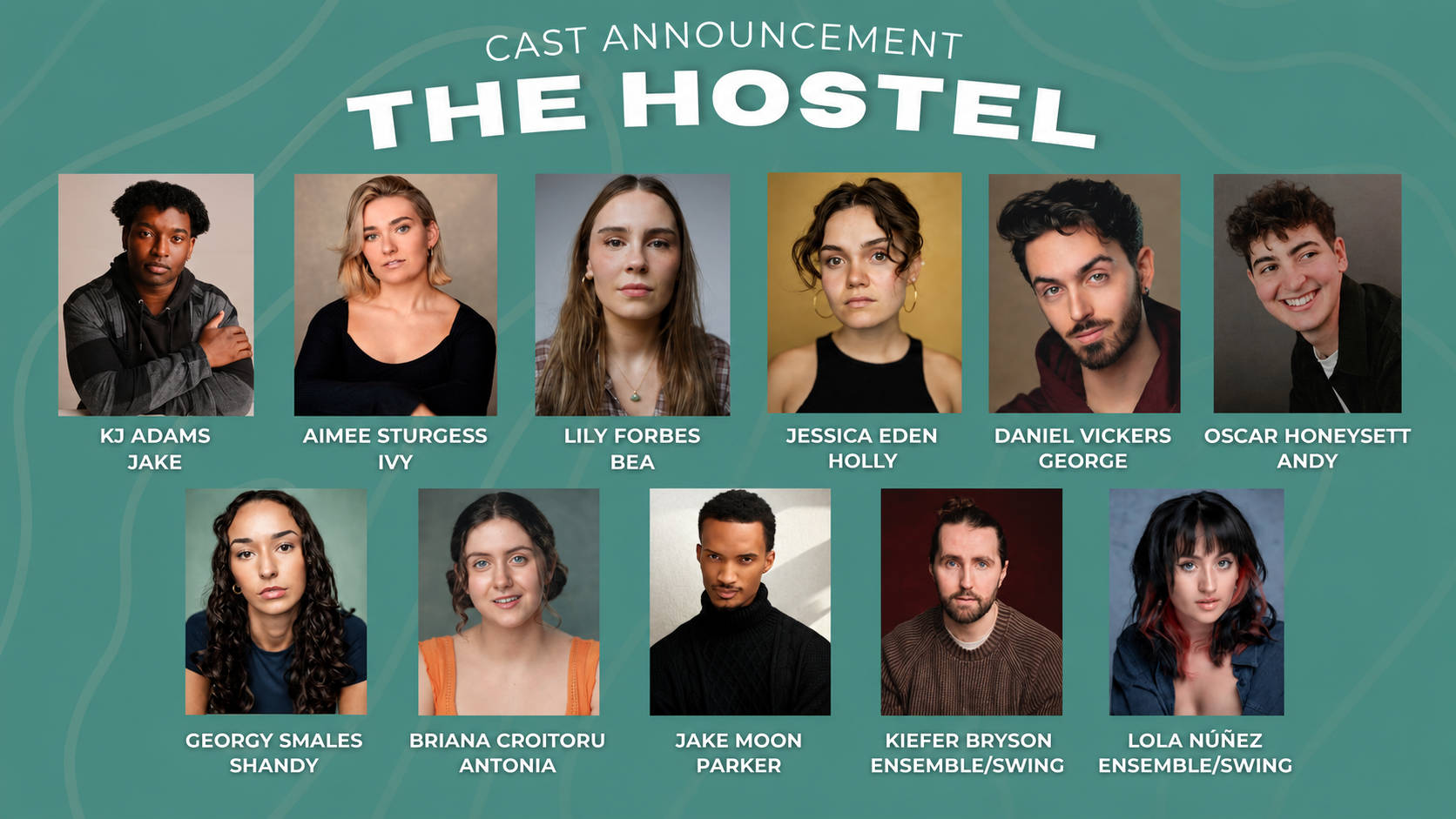
Aimee Sturgess as Ivy Newman
Lily Forbes as Bea Compton
Jessica Eden as Holly Browning
Daniel Vickers as George Croyder
Briana Croitoru as Antonia Bellingrave
Oscar Honeysett as Andy Jones
Georgy Smales as Shandy Jones
Jake Moon as Parker Westin
Lola Núñez as Ensemble / Female Swing
Kiefer Bryson as Ensemble / Male Swing
Annie Porter as Offstage Swing
An Energetic and Compassionate Ensemble Drama About Friendship and Consent
Summary
Isabella Haldren’s The Hostel begins as a lively comedy about a disastrous group holiday before developing into an energetic and compassionate ensemble drama about friendship, control, consent and the imperfect communities strangers can create.


Add comment